

For over a century, Charles-Louis Hanon’s The Virtuoso Pianist has remained a staple on music stands worldwide, revered by some as the foundation of finger technique and dismissed by others as mechanical drudgery. In an era where musicality and ergonomic health are paramount, modern pianists must approach these 19th-century drills with intention and anatomical awareness.
This guide analyzes the 60 exercises, balancing technical velocity and finger independence against repetitive strain risks. Learn contemporary practice strategies—from polyrhythmic variations to key transpositions—and evaluate classical alternatives to transform Hanon drills into an efficient, safe asset for your pianistic development.
Are Hanon Exercises Still Relevant for Modern Pianists?
Hanon exercises remain relevant for modern pianists when practiced with musical intention, anatomical awareness, and structured guidance rather than mindless mechanical repetition.
The Debate on the Utility of The Virtuoso Pianist
The debate surrounding The Virtuoso Pianist centers on whether isolated mechanical drills foster technical mastery or stifle expressive artistry.
First published in 1873, Charles-Louis Hanon designed his sixty exercises to develop finger independence, uniform tone, and velocity. Traditional pedagogues advocate for this systematic approach to build equal strength across all ten digits, particularly the weaker fourth and fifth fingers. Conversely, progressive educators emphasize that piano technique should develop within real musical literature, noting that phrasing, dynamic color, and tonal balance cannot emerge from uninflected repetition.
Contemporary piano pedagogy bridges this divide by treating mechanical exercises as purposeful physical conditioning. Technical drills produce the best results when they serve broader artistic repertoire, supporting music and brain development rather than functioning as isolated, monotonous routines.
Benefits for Improving Speed and Finger Independence
Systematic practice of Hanon exercises builds quantifiable finger independence, bilateral dexterity, and rhythmic velocity.
Key Technical Benefits:
- Isolating digit articulation: Builds independent neuromuscular control in the fourth and fifth fingers without compensatory hand collapse.
- Balancing bilateral coordination: Trains the non-dominant hand to match the dominant hand in articulation, dynamic weight, and clarity.
- Stabilizing keystroke consistency: Cultivates an even tactile touch, uniform weight transfer, and balanced tone production across both registers.
Pianists who incorporate structured technical drills into their daily piano practice routine develop the rapid velocity and clean articulation required for advanced repertoire by Chopin, Liszt, and Rachmaninoff. Professional concert pianists frequently utilize modified Hanon patterns as focused warm-up routines before rehearsals and performances.
Common Criticisms and Potential Risks of Injury
Unmonitored Hanon practice presents significant physiological risks, most notably repetitive strain injury (RSI) and tendonitis caused by accumulated muscular tension.
Primary Risk Factors:
- Static hand positioning: Locking the wrist or depressing the keybed with excessive downward force strains the flexor tendons.
- Mindless mechanical drilling: Practicing repetitive patterns without auditory focus breeds tension and deadens musical sensitivity.
- Excessive speed before coordination: Forcing tempo before establishing relaxed finger action triggers forearm tightness and pain.
Repetitive strain injuries develop quickly when students practice these patterns without proper technical supervision. Modern pedagogy prioritizes physical ease, supple wrist rotation, and intentional tension release after each keystroke to ensure injury-free progress.
Breakdown of The Virtuoso Pianist in 60 Exercises
Charles-Louis Hanon organized The Virtuoso Pianist into three progressive sections designed to systematically elevate pianistic facility from foundational coordination to virtuoso execution.
Hanon Exercises 1 to 20 for Beginners
Exercises 1 through 20 establish foundational finger independence, equal articulation, and basic hand agility in both hands.
Exercise Structure and Purpose:
- Exercises 1–5: Ascending and descending five-finger patterns focusing on vertical finger lift and lateral thumb flexibility.
- Exercises 6–10: Targeted workouts for the fourth and fifth fingers, strengthening weak extensor tendons.
- Exercises 11–20: Extended finger stretches, thumb crossings, and preparatory patterns for scalar fluency.
Exercise No. 1 remains the most widely practiced pattern, featuring an ascending five-finger figure that skips an interval between the first and second fingers (or fifth and fourth in the left hand). This fundamental pattern serves as an effective diagnostic tool to identify hand tension and measure finger evenness. Beginners should practice slowly with relaxed wrists. Experienced teachers often adapt these patterns to make piano fun for kids, ensuring engaging physical conditioning before bad habits take root.
Hanon Exercises 21 to 43 for Intermediate Development
Exercises 21 through 43 prepare intermediate pianists for demanding classical repertoire through extended arpeggios, complete scales, and wrist-release drills.
Advanced Pattern Development:
- Exercises 21–31: Agility drills reinforcing thumb-under passage, lateral forearm shifting, and finger flexibility.
- Exercises 32–38: Comprehensive thumb-crossing preparation across ascending and descending major and minor key pathways.
- Exercises 39–43: Complete major and minor scales and arpeggios through four octaves, building harmonic fluency and dynamic stamina.
These exercises develop the lateral wrist motion and coordination required for intermediate classical works by Bach, Mozart, and Beethoven. Varying practice tempos and dynamic levels maintains mental focus while cementing physical mechanics.
Advanced Techniques: Double Notes and Repetition
Exercises 44 through 60 introduce advanced virtuoso techniques, focusing on double notes, rapid note repetition, and octave bravura.
Specialized Technical Skills:
- Exercises 44–47: Double notes in thirds and sixths, demanding independent finger voicing and deep balance control.
- Exercises 48–53: Complex wrist flexibility exercises covering chromatic octaves, broken octaves, and alternating thirds.
- Exercises 54–60: Rapid note repetitions, tremolos, and sustained endurance patterns for concert-level repertoire.
The double-note exercises (44–54) develop the exact coordination and finger voicing needed for complex études by Chopin and Schumann. The rapid repetition studies (55–60) build the forearm endurance and supple wrist articulation essential for virtuosic concert pieces.
Jailbreaking Hanon: Contemporary Practice Methods
Contemporary piano pedagogy transforms rigid Hanon drills into dynamic, musically expressive studies through creative practice modifications that prioritize musicality and physical ease.
Using Exercise No. 1 for Different Musical Purposes
Exercise No. 1 serves as an adaptable laboratory for exploring phrasing, dynamic shaping, and touch control beyond mechanical finger drills.
Creative Practice Applications:
- Dynamic contouring: Shaping phrases from pianissimo to fortissimo to develop expressive touch and fingertip sensitivity.
- Touch contrast: Alternating legato touch in the right hand with crisp staccato in the left hand to sharpen bilateral coordination.
- Expressive timing: Incorporating subtle rubato and agogic accents to connect mechanical motion with musical breathing.
Treating Exercise No. 1 as an expressive mini-étude bridges the gap between raw physical facility and nuanced interpretive artistry.
Practicing Hanon Exercises in All 12 Keys
Transposing Hanon exercises through all 12 keys develops spatial keyboard awareness, tactile confidence, and practical music theory comprehension.
Benefits of Key Transposition:
- Keyboard topography awareness: Navigating black and white key combinations trains the hands to adjust arch height naturally.
- Harmonic fluency: Cementing spatial recall of key signatures accelerates sight-reading and score analysis.
- Improvisational freedom: Facility in all twelve keys strengthens relative pitch and tonal memory across the entire keyboard.
Practicing exercises in multiple keys prepares pianists for the shifting tonal terrain of advanced repertoire. This exercise is especially valuable for musicians developing a jazz piano walking bass, where fluid navigation through all 12 keys is essential.
Integrating Rhythm and Dynamic Variations
Modifying rhythm and articulation patterns prevents mechanical habituation and accelerates neuromuscular coordination.
Advanced Practice Modifications:
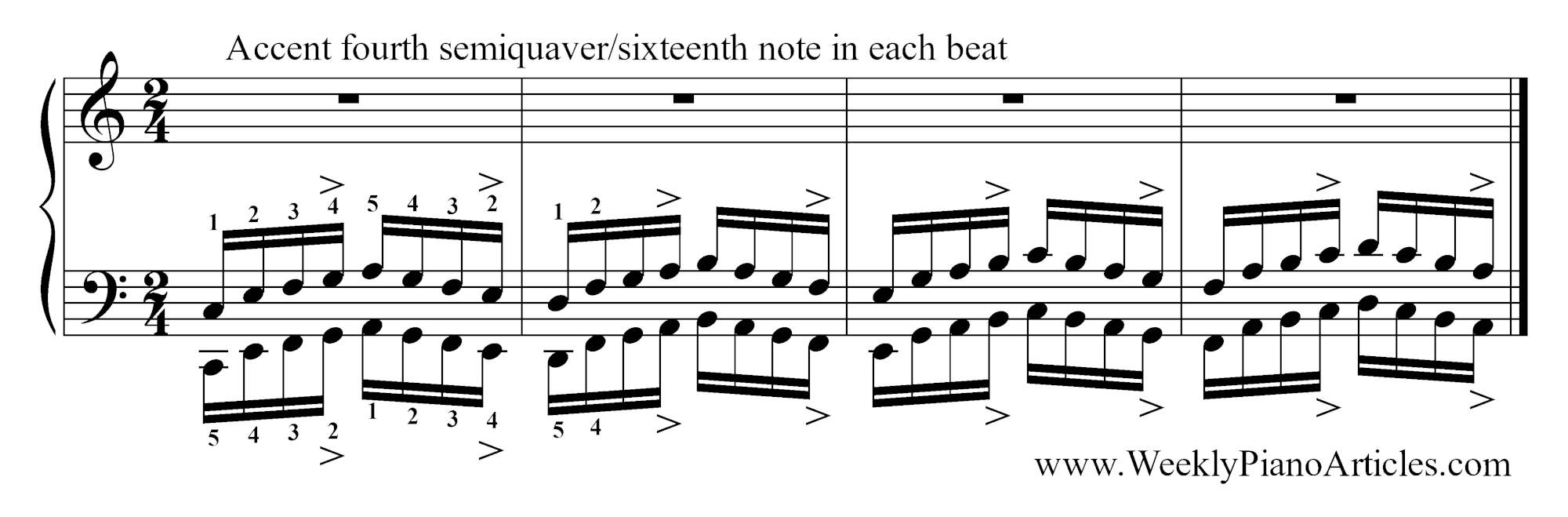
- Dotted rhythms: Alternating dotted eighth-sixteenth and sixteenth-dotted eighth patterns to isolate fast finger bursts with built-in relaxation pauses.
- Metric shifting: Regrouping straight sixteenth notes into triplets or syncopated accents to sharpen internal pulse.
- Poly-articulation: Playing one hand legato and the opposite hand staccato across dynamic contrasts to master polyphonic independence.
Rhythmic variations train the brain to process note sequences in varied clusters, making finger articulation precise and dependable during challenging performance passages.
Alternatives to Hanon for Piano Technique Improvement
Modern educators frequently complement or replace Hanon drills with diverse etudes and direct repertoire extraction to nurture both technique and musical sensitivity.
Comparing Hanon vs Czerny and Brahms Exercises
Choosing between technical exercise collections depends on a student’s technical maturity, harmonic understanding, and artistic goals.
Pedagogical Comparison:
- Czerny études (e.g., Op. 599, Op. 299): Melodic studies embedded in classical harmonic structures that develop velocity, phrasing, and formal awareness.
- Brahms exercises (51 Exercises): Sophisticated polyphonic and rhythmic studies designed for advanced finger counterpoint and hand balance.
- Hanon exercises (The Virtuoso Pianist): Uninflected, symmetrical drills focusing strictly on isolated neuromuscular mechanics.
While Hanon provides symmetrical finger conditioning, Czerny connects velocity with classical phrasing, and Brahms cultivates deep polyphonic voicing.
Focus on Musicality Over Mechanical Repetition
Modern piano pedagogy prioritizes extracting technical exercises directly from masterwork repertoire rather than relying solely on dry drill books.
Musical Approach Benefits:
- Direct musical relevance: Isolate demanding measures from Chopin, Bach, or Beethoven to practice technical mechanics in authentic musical context.
- Ergonomic sustainability: Varied repertoire practice reduces repetitive strain by continuously altering hand shapes and dynamic levels.
- Artistic engagement: Practicing expressive phrases maintains practice motivation and strengthens auditory sensitivity.
Integrating technical workouts with sight-reading, ear training, and harmonic analysis ensures that mechanical dexterity always serves artistic expression.
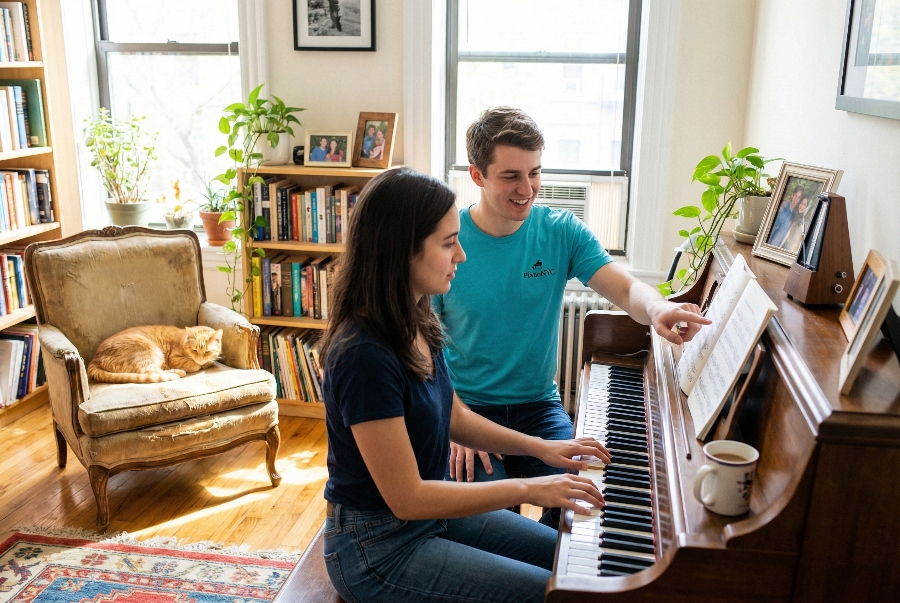
Enhancing Technique with Private Piano Lessons in New York City
Personalized 1-on-1 instruction provides essential guidance for safe technical mastery, combining biomechanical oversight with custom repertoire planning.
The Role of a Mentor in Correcting Posture and Hand Shape
An expert mentor identifies subtle physical tensions and postural misalignments that self-directed students cannot detect.
Essential Instructional Elements:
- Biomechanical assessment: Adjusting bench height, elbow angles, and wrist flexibility to optimize arm weight distribution.
- Tension diagnosis: Identifying and eliminating static shoulder tightness, collapsed finger arches, and keybed pressing.
- Targeted corrective drills: Assigning customized technical exercises tailored to individual hand anatomy and repertoire goals.
Professional instructors at PrivatePianoLessons supervise physical mechanics directly at the piano, ensuring each student develops velocity and power safely without risk of injury.
Tailored Skill-Building Curriculum at PrivatePianoLessons
PrivatePianoLessons provides structured 1-on-1 in-home piano instruction across all five boroughs of New York City, tailored to each student’s goals and physical needs.
Curriculum Components:
- In-home 1-on-1 lessons: Personalized instruction on your own piano in Manhattan, Brooklyn, Queens, The Bronx, and Staten Island with 0 USD travel fees.
- Conservatory-trained faculty: A team of 48 background-checked teachers holding Bachelor of Music degrees or higher, including 19 with Master’s or Doctoral degrees.
- Structured 8-level roadmap: Curriculum benchmarks aligned with RCM Certificate Program and ABRSM standards, featuring written progress reports every 12 weeks.
Coordinated from its Upper West Side headquarters at 817 W End Ave, New York, NY 10025, PrivatePianoLessons offers a complimentary 30-minute in-home evaluation session to assess hand posture, instrument setup, and learning objectives.
FAQ
What Are the Main Benefits of Practicing Hanon Exercises?
Hanon exercises develop finger independence, bilateral hand coordination, and keystroke velocity through systematic 60-pattern drills. Regular, mindful practice builds physical endurance and neuromuscular clarity across all ten digits, particularly strengthening the fourth and fifth fingers for demanding classical repertoire.
How Should Beginners Approach Hanon Exercise No. 1?
Beginners should practice Hanon Exercise No. 1 slowly at a tempo of 60 beats per minute with relaxed wrists and curved fingers. Prioritize even tone production and zero forearm tension over speed. Increase tempo gradually on a metronome only after the pattern feels effortless.
Are There Risks Associated with Hanon Practice?
Improper Hanon practice carries significant risks of repetitive strain injuries, tendonitis, and habituated muscular tension. Practicing with stiff wrists or for excessive durations without breaks strains forearm tendons. Guidance from an experienced teacher ensures safe, ergonomic execution.
How Do Modern Teachers Modify Traditional Hanon Practice?
Modern teachers modify Hanon exercises by integrating rhythmic variations, dynamic contrasts, articulation changes, and transposition into all 12 keys. These contemporary methods transform repetitive drills into expressive musical études that sharpen auditory listening and harmonic awareness.
Why Choose PrivatePianoLessons for Technical Development?
PrivatePianoLessons delivers personalized 1-on-1 in-home instruction across New York City from 48 conservatory-trained, background-checked piano instructors. Lessons take place on your own piano with customized technical regimens referencing RCM and ABRSM benchmarks, zero travel fees, and a complimentary 30-minute in-home evaluation.
