
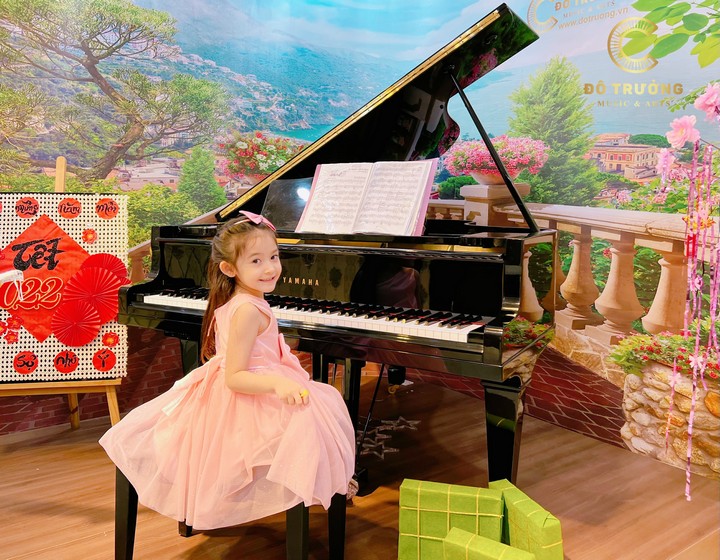
Parents often evaluate when their child should begin piano instruction. Music education experts consistently recommend starting between ages 5 and 9 for optimal learning outcomes. This age range provides the ideal balance of:
- Physical coordination,
- Cognitive development, and
- Attention span necessary for successful private piano study.
Children within this developmental stage possess the fine motor skills required to depress individual piano keys independently. They distinguish left from right, count rhythmic beats up to four, and maintain focus during 30-minute lessons. These foundational competencies establish an effective framework for structured musical education.
The Ideal Age Range to Begin Piano Lessons
Children between 5 and 9 years old demonstrate the highest developmental readiness for formal piano instruction. During this formative window, neuroplasticity remains peak, accelerating auditory processing, physical coordination, and musical concept comprehension.
Five-year-olds typically possess the physical hand span required to cover five adjacent white keys comfortably. Their finger independence allows them to strike individual keys without inadvertently collapsing adjacent knuckles. Cognitive abilities expand to support:
- Basic visual pattern recognition,
- Spatial-temporal reasoning, and
- Sequential memory processing.
Ages 6 through 8 represent the optimal starting window for most young learners. Physical growth delivers sufficient hand size and finger tendon strength for balanced key depression. Mental maturity enables children to read musical notation and execute multi-step instructions. Emotional development supports consistent practice habits and receptive feedback processing.
Nine-year-olds exhibit enhanced concentration, self-discipline, and abstract reasoning for advanced piano repertoire. They grasp practice commitments, develop nuanced expressive dynamics, and process complex rhythmic subdivisions.
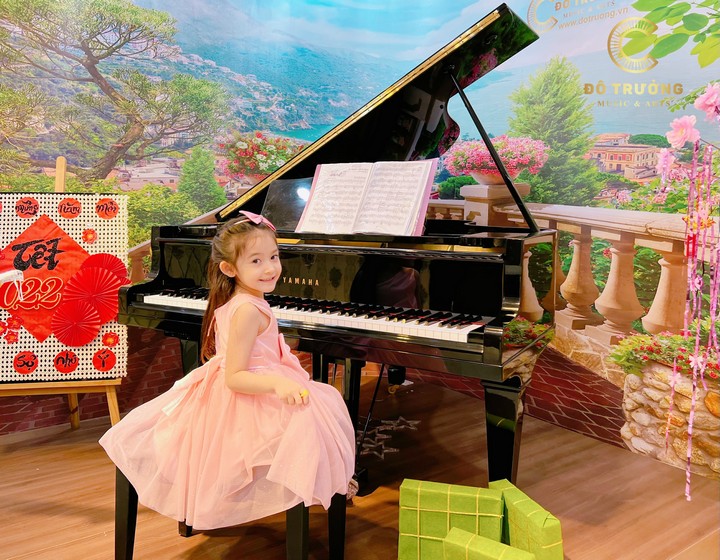
Signs Your Child Is Ready to Start Piano Lessons
Parents can determine lesson readiness by observing developmental markers across physical, cognitive, and behavioral domains. Evaluating these specific indicators ensures appropriate lesson timing and long-term musical engagement.
Hand Size and Finger Independence
Physical readiness forms the structural foundation of sound piano technique. A child’s hand must span approximately 15 cm (6 inches) to navigate five adjacent white keys without physical strain. This skeletal development generally solidifies around age 5 or 6.
Finger independence serves as an essential neuromuscular marker. You can assess this control by asking your child to wiggle each finger independently while resting their palm flat on a table. Smooth, isolated movement indicates sufficient motor differentiation for early keyboard exercises.
Hand-eye coordination directly supports keyboard navigation and sheet music tracking. Children should accurately point to small visual targets and manipulate fine objects with control. These motor skills translate directly into reading the Grand Staff while executing accurate keystrokes.
Reading and Counting Ability
Basic symbolic literacy significantly accelerates early piano comprehension. Students benefit from recognizing alphabet letters A through G, which designate musical pitches across the staff. Number familiarity from 1 through 5 is necessary for interpreting standard piano fingering systems.
Text comprehension supports independent practice between weekly lessons. Standard instructional method books feature written tempo indications, practice directives, and brief narrative exercises. Early readers navigate these materials with greater autonomy and confidence.
Rhythmic counting forms the mathematical core of musical performance. The ability to count steady pulses up to four enables students to master basic time signatures, meter subdivisions, and structured piano rhythm exercises.
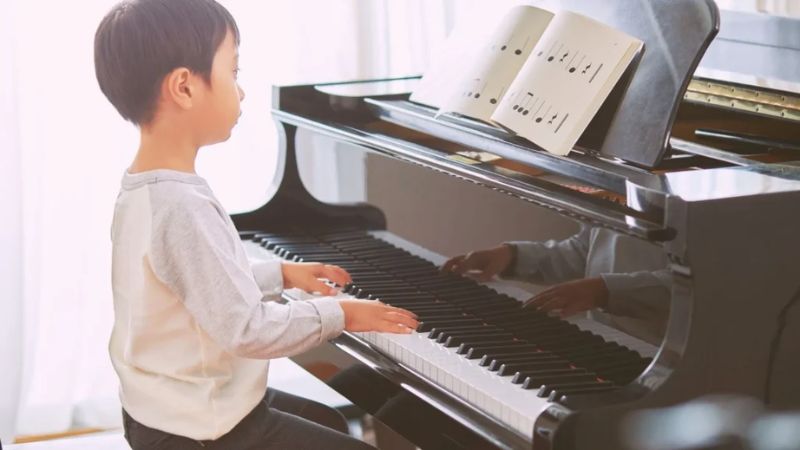
Interest in Music and Desire to Learn
Genuine musical interest represents the most reliable predictor of lasting piano success. Children who demonstrate natural curiosity toward piano tones, melodies, and rhythmic beats exhibit the intrinsic motivation required for progressive study.
Observe your child’s spontaneous response to recorded or live instrumental music. Children show early musical aptitude when they dance in tempo, sing along accurately, or inquire about instrumental mechanics. Inquiring about the historical context or history of piano music further reflects an intellectual connection to the instrument.
Self-initiated keyboard exploration indicates prime learning readiness. Children who voluntarily approach the piano to experiment with sounds or repeatedly ask for formal lessons demonstrate the intrinsic commitment needed for steady advancement.
Attention Span and Concentration
Introductory private piano lessons require sustained cognitive focus for 30 minutes. Students must comfortably concentrate on a single structured learning task for this duration before beginning formal private study.
Attention capacities evolve significantly alongside chronological age. Four-year-olds typically sustain focused attention for 10 to 15 minutes, whereas 7-year-olds maintain engagement across 30-minute lesson intervals. Selecting lesson lengths that match your child’s attention span prevents cognitive fatigue.
Concentration builds progressively through structured daily routines. Engaging in focused activities such as puzzle assembly, drawing, and dedicated reading sessions builds the cognitive endurance required for formal keyboard study.
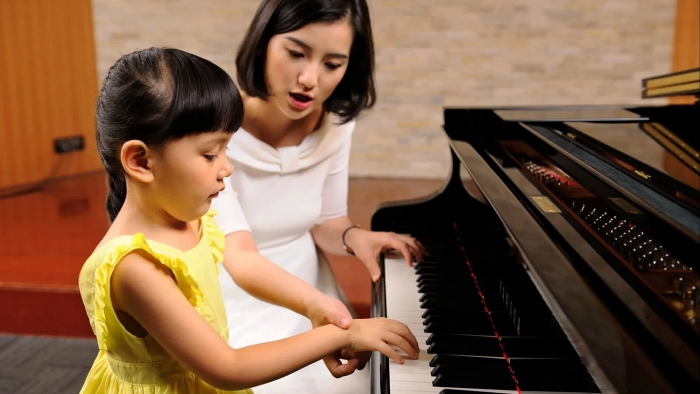
Starting Piano at Different Developmental Stages
Each developmental stage provides distinct pedagogical opportunities and challenges for piano education. Understanding these specific age brackets helps parents choose the optimal instructional starting point.
Can a 3 to 5 Year Old Learn Piano?
Children aged 3 to 5 can explore the keyboard productively, although formal notation study is often premature. Three-year-olds generally lack the fine motor control and sustained attention span needed for analytical piano drills.
Four- and 5-year-olds frequently demonstrate advanced readiness for structured musical play. Instruction at this age must remain sensory, interactive, and play-oriented rather than heavily analytical. Effective early exploration develops:
- Auditory discrimination between high and low pitch registers,
- Steady physical pulse and rhythmic coordination, and
- Keyboard geography familiarity across black and white key groupings.
Aural-based methods, such as the Suzuki approach, accommodate early childhood learners through listening, imitation, and parental partnership prior to introducing staff notation.
Why Ages 6 to 9 Are Often Considered the Best Time
The 6 to 9 age window provides the ideal convergence of physical capability, cognitive processing, and emotional maturity. Physical development provides adequate hand size, finger arch stability, and tendon strength for proper key descent.
Cognitive growth enables simultaneous multi-track processing during this stage. Children coordinate reading musical notation on the page while executing precise bilateral hand movements on the keyboard. Concrete operational thinking allows them to understand scale intervals, triad structures, and rhythmic fractions.
Emotional maturation supports consistent daily practice habits and receptive learning. Students understand the direct correlation between structured practice and audible skill refinement. Socially, children articulate questions clearly and collaborate constructively with their instructor.
Is It Too Late for Teens to Start Piano?
Teenagers can begin piano study with remarkable efficiency and artistic depth. Mature abstract reasoning allows adolescents to grasp complex music theory, chord constructions, and voice leading significantly faster than younger children.
Full physical development provides adult hand size, span, and finger strength. Adolescents tackle technical repertoire, octave reaches, and demanding dynamic ranges without physical limitations. Their refined fine motor control enables rapid execution of intricate repertoire.
Intrinsic motivation drives adolescent musical advancement. Teenagers select specific musical genres they genuinely love, which fuels disciplined self-directed practice. This same internal drive explains why piano for returning adults produces rapid, rewarding results.
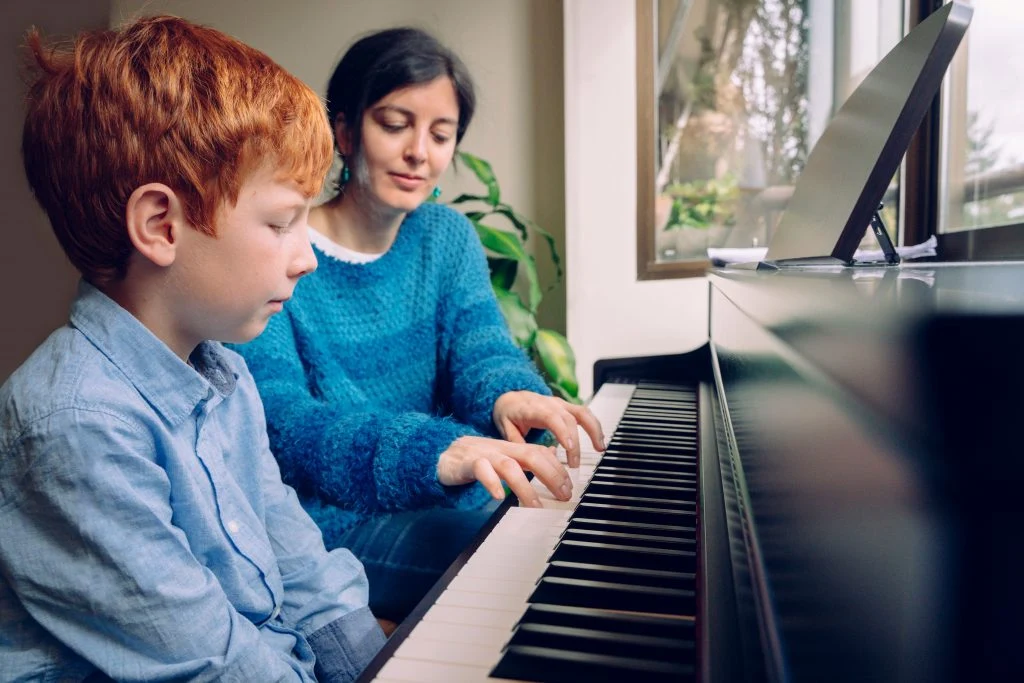
Benefits of Learning Piano at a Young Age
Early piano training delivers profound developmental benefits that enrich cognitive processing, academic proficiency, and emotional regulation across a child’s life.
Piano education strengthens neural connectivity, working memory, and executive function. Performing music requires real-time coordination of visual notation, auditory feedback, and fine tactile execution. This rigorous mental exercise enhances spatial reasoning and information-processing speed across academic disciplines.
Mathematical aptitude improves directly through practical rhythm study. Fundamental musical concepts reinforce numerical comprehension, including:
- Fractional relationships in note values,
- Proportional ratios in metric time signatures, and
- Geometric symmetry across keyboard interval patterns.
Language acquisition and auditory processing accelerate through early ear training. Piano study refines pitch discrimination, sequential memory, and phonological awareness. These auditory competencies directly enhance verbal memory, reading fluency, and foreign language comprehension.
Emotional resilience deepens as children master expressive interpretation and overcome performance anxiety. Working through technical challenges teaches patience and emotional regulation. Comparable therapeutic benefits appear in clinical research examining the benefits of music for elderly adults, confirming that musical expression enhances neurological health across every lifecycle phase.
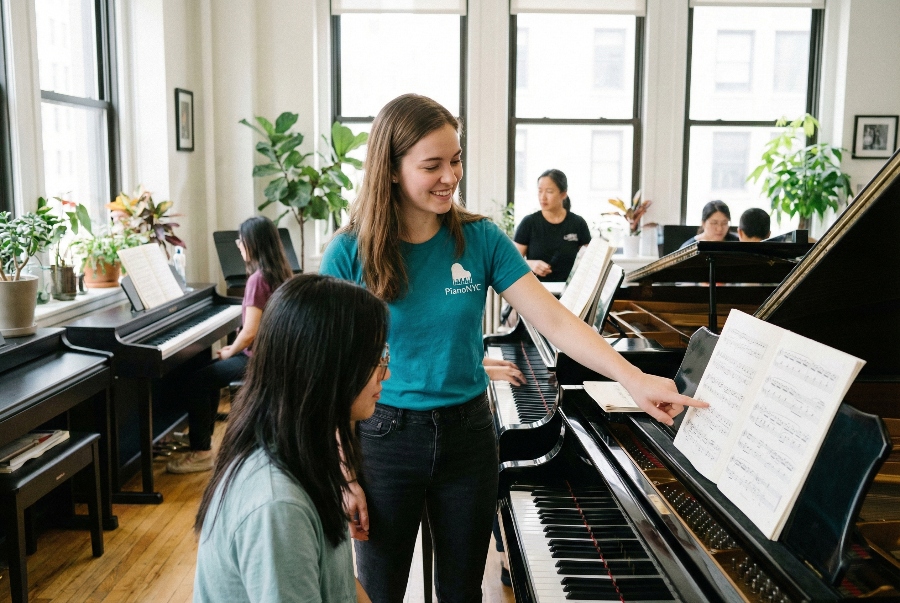
Tips for Parents When Starting Piano Lessons
Parental guidance and a structured home environment directly foster a young pianist’s long-term musical growth and enthusiasm.
Establish a quiet, well-lit practice area dedicated exclusively to musical study. Ensure your instrument features 88 fully weighted keys to support authentic touch sensitivity. Position the piano bench so your child maintains a balanced, ergonomic piano sitting position with elbows level with the keys and feet grounded on a footstool.
Implement consistent daily practice windows integrated into your child’s regular routine. Short, focused daily sessions outperform sporadic, lengthy practice blocks. Begin with 10 to 15 minutes daily for young beginners, gradually extending practice duration as technical repertoire expands.
Maintain realistic developmental expectations regarding musical progress. Instrumental mastery develops through cyclical plateaus and breakthroughs rather than linear advancement. Focus praise on diligent effort, attentive posture, and daily consistency rather than immediate technical perfection.
Collaborate actively with your child’s private piano teacher. Review weekly assignment logs, clarify home practice objectives, and maintain regular communication regarding your child’s enthusiasm and challenges.
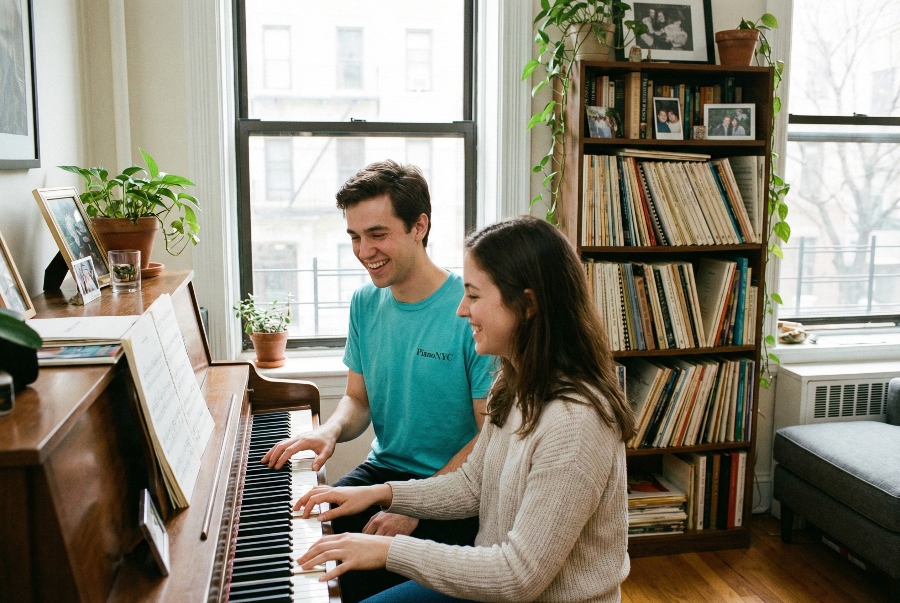
Private Piano Lessons in New York City with PrivatePianoLessons
PrivatePianoLessons provides premier 1-on-1 private in-home piano instruction throughout New York City, tailoring lessons to each student’s developmental stage and musical goals.
Founded on May 12, 2010, by classical pianist and educator James Harrison, PrivatePianoLessons features a faculty of 48 thoroughly vetted, background-checked instructors holding music degrees from institutions such as The Juilliard School and Manhattan School of Music. Instruction follows an 8-level curriculum aligned with the Royal Conservatory of Music (RCM) and ABRSM standards.
Lessons take place directly in the comfort of your home, eliminating commute times. Instructors travel across all five boroughs with 0 USD travel fees, serving families in:
- Manhattan,
- Brooklyn,
- Queens,
- The Bronx, and
- Staten Island.
PrivatePianoLessons offers a complimentary 30-minute in-home assessment to evaluate your child’s readiness, hand coordination, and instrument setup. Lessons are available Monday through Sunday from 07:00 to 21:00. Schedule an assessment by calling +1 (917) 903-2146, emailing [email protected], or visiting privatepianonyc.com (Dispatch Headquarters: 817 W End Ave, New York, NY 10025, USA).
Frequently Asked Questions (FAQs)
Below are answers to frequently asked questions regarding the ideal age to begin private piano instruction.
What Is the Ideal Age to Begin Formal Piano Lessons?
The ideal age to begin formal piano lessons is between 5 and 9 years old. This developmental window balances fine motor control for independent finger movement, cognitive maturity for 30-minute lesson focus, and heightened neuroplasticity for rapid musical absorption.
What Are the Key Signs That Your Child Is Ready for Piano Lessons?
The key signs that your child is ready for piano lessons include physical hand span, basic literacy and numeracy, sustained attention span, and intrinsic musical interest. Specifically, your child should comfortably span five adjacent white keys (approximately 15 cm or 6 inches), identify letters A through G, count to four, and sustain focus for 30 minutes.
What Are the Specific Benefits of Starting Piano Lessons Between Ages 6 and 9?
The specific benefits of starting piano lessons between ages 6 and 9 are accelerated cognitive development, enhanced fine motor coordination, improved academic performance, and structured emotional maturity. Children in this age window process abstract musical notation efficiently, integrate constructive feedback, and build disciplined daily practice habits.
