

Improvisational pianists rely on lead sheets and fake books as foundational tools for performance, harmonization, and creative interpretation. These streamlined notations provide the melody line, chord symbols, and lyrics, enabling musicians to personalize standard jazz repertoire rather than adhering to rigid classical arrangements when learning how to play Moonlight Sonata.
Understanding Lead Sheets and Fake Books
What is a Lead Sheet?
A lead sheet is an abbreviated musical score that outlines a composition through 3 core elements: melody notation, harmonic chord symbols, and lyrics. Jazz pianists use lead sheets to interpret harmonic frameworks spontaneously rather than executing fully arranged sheet music.
Lead sheets provide the essential structural framework of jazz standards, enabling musicians to:
- Sight-read chord progressions with speed and accuracy
- Create personalized harmonic voicings for classic compositions
- Expand performance repertoire efficiently without memorizing multi-page scores
- Focus on creative improvisation and rhythmic expression
This compact format removes pre-written left-hand accompaniments, explicit voice-leading, and rigid rhythmic patterns found in traditional classical scores. Pianists use this framework to develop an authentic musical voice through real-time reharmonization.

Difference Between Fake Book / Real Book
The distinction between a fake book and a Real Book centers on transcription accuracy, legal publishing, and historical origin. Early fake books allowed professional musicians to “fake” accompaniments on unfamiliar songs at commercial engagements.
Fake Books:
- Originated as unauthorized underground transcriptions during the 1940s and 1950s
- Featured simplified chord charts and handwritten melodic lines
- Supplied working pianists with hundreds of tunes in portable binders
- Contained frequent harmonic errors, omitted sections, and inconsistent notation
Real Books:
- Originated in the 1970s at Berklee College of Music as accurate, student-compiled editions
- Introduced standardized chord changes, legible handwritten music fonts, and correct melodies
- Established the standard performance curriculum for jazz education and professional jam sessions
- Organized compositions alphabetically by song title for rapid stage navigation
PrivatePianoLessons instructors utilize both resources to teach foundational lead sheet interpretation. This systematic framework is also standard practice across institutional music schools in NYC.
The History of Jazz Fake Books
The history of jazz fake books spans 8 decades of underground distribution, academic standardization, and digital evolution. Professional dance band musicians in the 1940s required portable song indexes to satisfy audience requests across ballrooms and nightclubs.
The evolution of fake books follows 4 major developmental milestones:
- 1940s–1950s: Underground tune binders circulated among professional working musicians
- 1970s: The first Real Book edition emerged from students at Berklee College of Music
- 1980s–1990s: Publisher Hal Leonard released legally licensed Real Book editions with verified composer royalties
- 2000s–present: Digital tablet applications and searchable PDF libraries replaced heavy physical volumes
Modern legal collections preserve the historical repertoire while resolving copyright issues and standardizing chord symbols across all musical keys.

How to Play from a Lead Sheet
Decoding Melody and Chord Symbols
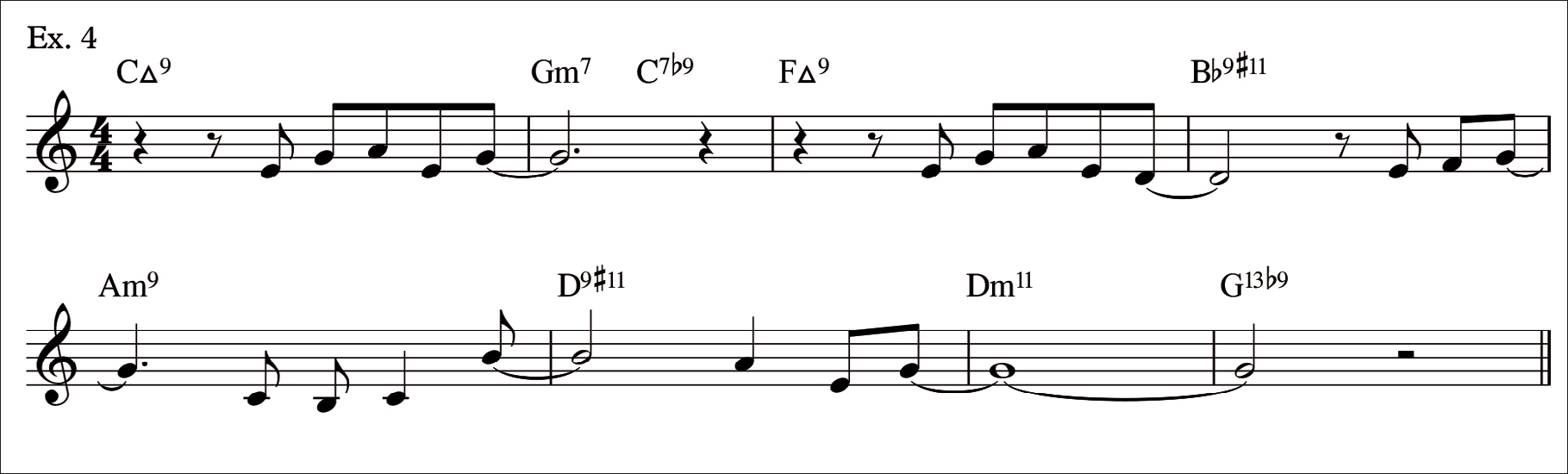
Playing from a lead sheet requires decoding the treble clef melody in the right hand while translating harmonic shorthand into multi-note voicings in the left hand. The melody defines the song’s phrasing, while chord symbols dictate harmonic movement, bass lines, and tension extensions.
Standard jazz chord notation relies on 4 primary chord families:
- CMaj7: Major 7th chord containing C-E-G-B (root, major 3rd, perfect 5th, major 7th)
- Dm7: Minor 7th chord containing D-F-A-C (root, minor 3rd, perfect 5th, minor 7th)
- G7: Dominant 7th chord containing G-B-D-F (root, major 3rd, perfect 5th, minor 7th)
- Am7b5: Half-diminished 7th chord containing A-C-Eb-G (root, minor 3rd, diminished 5th, minor 7th)
Mastering these foundational 4-note structures is the initial phase when learning jazz piano chords for beginners across standard 12-bar blues and 32-bar song forms.
Interpreting jazz melodies requires phrasing techniques beyond literal notation. Pianists apply swing eighth notes, syncopated anticipations, and decorative grace notes to achieve an authentic jazz feel.
Core melodic interpretation skills include:
- Anticipating downbeats by attacking melodic notes an eighth note early
- Applying legato phrasing with subtle dynamic inflections on off-beats
- Adding chromatic enclosures, turns, and neighboring tones to focal pitches
- Analyzing standard 32-bar AABA and ABAC song forms
Left Hand Voicing Strategies
Left-hand voicing strategies provide harmonic foundation and rhythmic groove while freeing the right hand to perform melodies or solos. Jazz pianists select specific voicings based on tempo, musical context, and ensemble size.
Shell Voicings:
Shell voicings use 2 or 3 essential guide tones—the root, 3rd, and 7th—to outline the harmony with clarity:
- CMaj7: Play C in the bass with B and E above (root, 7th, 3rd)
- G7: Play G in the bass with F and B above (root, 7th, 3rd)
- Dm7: Play D in the bass with C and F above (root, 7th, 3rd)
Rootless Voicings:
Rootless voicings omit the tonic note to incorporate color tones such as the 9th, 11th, and 13th, which are ideal when a bassist supplies the root:
- Dm7 (Form A): Play F-A-C-E (3rd, 5th, 7th, 9th)
- G7 (Form A): Play F-A-B-E (7th, 9th, 3rd, 13th)
- CMaj7 (Form A): Play E-G-B-D (3rd, 5th, 7th, 9th)
Four-Note Block Chords:
Four-note block voicings combine the root, 3rd, 5th, and 7th in close position to deliver full sonic support during solo piano arrangements.
Applying Private Piano Lessons at New York City Techniques
Structured piano lessons New York City students receive provide an organized roadmap for translating lead sheets into polished musical performances. Instruction bridges theoretical chord knowledge with real-time keyboard execution.
Structured 8-Week Lead Sheet Curriculum:
- Weeks 1–2: Identify chord symbols and build diatonic 7th shell voicings
- Weeks 3–4: Harmonize standards using guide tones with right-hand melodic syncopation
- Weeks 5–6: Introduce rootless voicings, ii–V–I progressions, and basic tritone substitutions
- Weeks 7–8: Execute complete solo piano arrangements with intros, heads, and outros
Consistent progress relies on focused, deliberate practice routines. Dedicating 20 to 30 minutes daily to hands-separate work enables pianists to internalize voicings before combining them with complex melodies. Recording practice sessions allows students to evaluate swing feel and implement first piano recital tips prior to live performances.
Essential Fake Books for Improvisational Pianists
The Standards Real Book C Edition
The Standards Real Book C Edition by Sher Music Co. is a comprehensive collection containing over 240 classic standards from the Great American Songbook. This volume features verified composer chord voicings, alternate changes, and clean engraving.
Key attributes include:
- Transcriptions audited by professional jazz educators and performing artists
- Historical standards spanning the 1920s through the 1960s
- Clear chord symbol notation with detailed composer chord substitutions
- Alphabetical index for rapid navigation during live performances
Representative standards in this collection include “All the Things You Are” by Jerome Kern, “Body and Soul” by Johnny Green, “Misty” by Erroll Garner, and “Take Five” by Paul Desmond.
The Real Bebop Book
The Real Bebop Book compiles defining compositions from the 1940s and 1950s bebop movement, presenting advanced melodic lines over rapid harmonic changes. This volume serves intermediate and advanced pianists who are expanding their linear improvisation techniques.
Bebop literature features 4 technical demands:
- Fast tempos ranging from 140 to 220 BPM (beats per minute)
- Dense harmonic movement with chords changing every 2 beats
- Chromatic approach notes, altered 9ths, and sharp 11th tensions
- Asymmetrical phrase lengths that cross formal bar lines
Featured composers include Charlie Parker (“Confirmation,” “Ornithology”), Dizzy Gillespie (“A Night in Tunisia”), Bud Powell (“Parisian Thoroughfare”), and Thelonious Monk (“‘Round Midnight”).
Bill Evans / Miles Davis Real Books
The Bill Evans and Miles Davis Real Books document the development of modal jazz, impressionistic voicings, and introspective ballad arrangements. These volumes capture the transition from traditional functional harmony to open modal vamps.
The Bill Evans Real Book provides:
- Modal masterpieces including “Waltz for Debby” and “Peace Piece”
- Lush rootless quartal voicings influenced by Claude Debussy and Maurice Ravel
- Reharmonized ballad arrangements featuring altered dominant substitutions
- Inner-voice counterpoint lines within close-position harmonies
The Miles Davis Real Book provides:
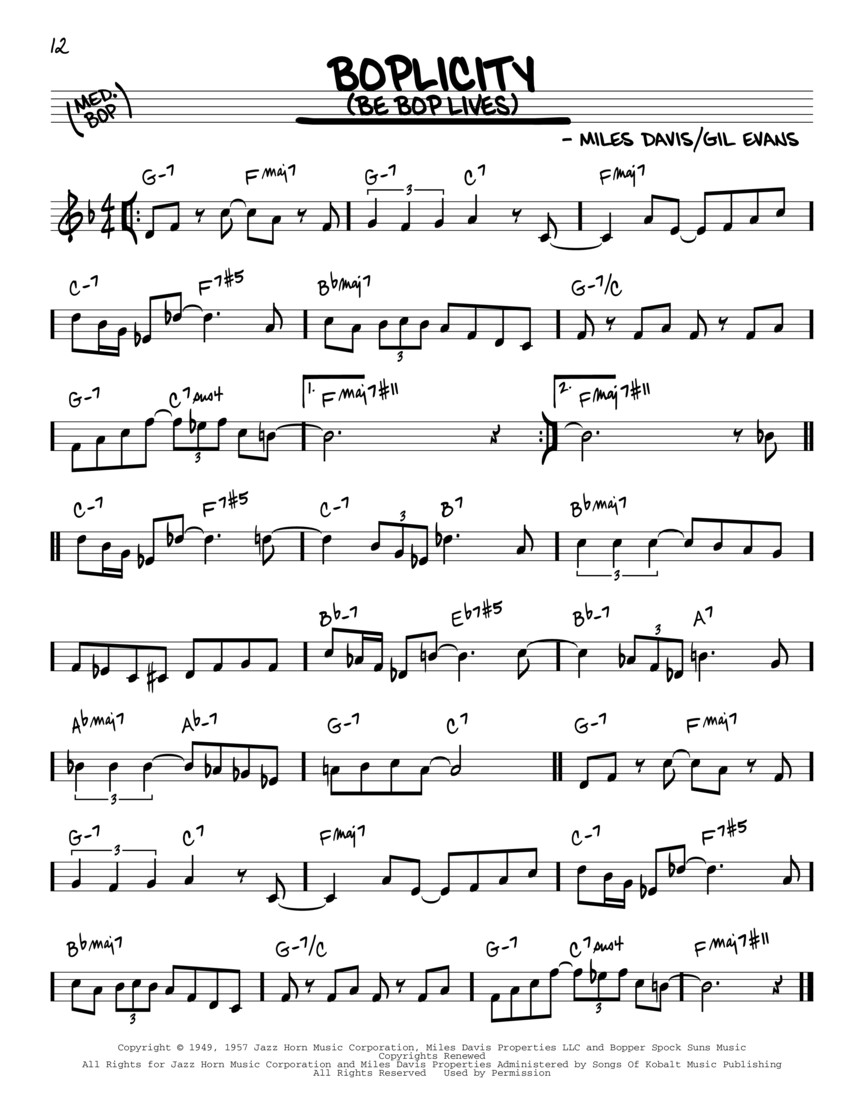
- Landmark modal frameworks including “So What” and “All Blues”
- Key compositions across cool jazz, hard bop, and fusion eras
- Direct transcriptions from classic 1950s and 1960s quintet recording sessions
- Linear modal melodies built on Dorian and Mixolydian scales
The All-Improvisational Music Real Book
The All-Music Real Book offers an expansive single-volume anthology of over 400 pieces, covering traditional swing, bebop, bossa nova, and contemporary post-bop styles. This comprehensive reference supports pianists building cross-genre versatility.
Historical and stylistic coverage includes:
- Swing standards: “Take the ‘A’ Train” and “In a Sentimental Mood”
- Bossa nova classics: “The Girl from Ipanema” and “Corcovado” by Antonio Carlos Jobim
- Modern modal works: “Maiden Voyage” by Herbie Hancock and “Giant Steps” by John Coltrane
- Contemporary compositions by Pat Metheny, Chick Corea, and Keith Jarrett
Common Problems with Lead Sheets
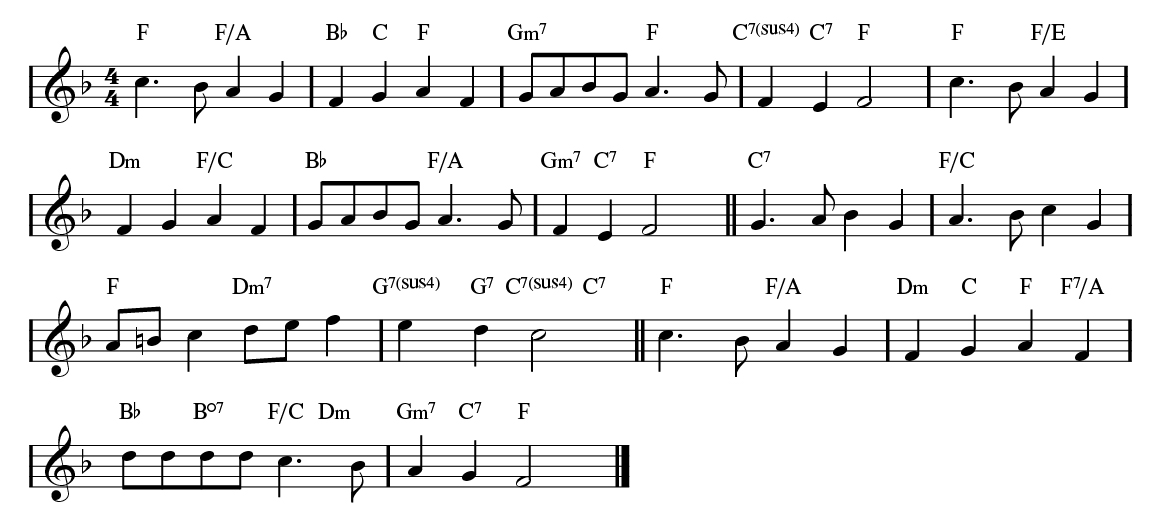
Pianists working with lead sheets encounter recurring notation discrepancies, incomplete charts, and absent performance directions. Recognizing these limitations helps musicians apply external listening analysis to correct inaccurate charts.
Transcription Inaccuracies:
Early bootleg fake books contain notable errors resulting from inaccurate ear transcriptions. Common notation problems include:
- Incorrect chord qualities (such as dominant 7ths printed in place of minor 7ths)
- Omitted harmonic turnarounds and passing chords
- Inaccurate melody pitches that conflict with original recordings
- Misidentified song forms (such as omitting a 2-bar tag or interlude)
Absence of Performance Markings:
Lead sheets omit essential interpretive guidance, requiring the performer to supply:
- Specific tempo designations, groove styles, and swing percentages
- Dynamic markings, phrase articulations, and pedaling instructions
- Left-hand accompaniment patterns and register spacing
- Definitive intro and coda arrangements
Digital PDF Collections vs Physical Books
Modern jazz pianists select between digital tablet software and printed music books based on portability, readability, and performance reliability.
Advantages of Digital Collections:
- Immediate storage of thousands of lead sheets on a single portable tablet
- Instant search filtering by song title, composer, key signature, or tempo
- One-touch transposition tools in specialized chart applications
- Cloud backup synchronization across iPads, computers, and mobile devices
Advantages of Physical Books:
- Zero battery dependence, eliminating hardware shutdowns during live engagements
- High visual contrast on large paper under bright stage lighting
- Direct pencil annotations for quick voicing alterations and fingering notes
- Tactile two-page layouts without screen navigation delays
Recommended Digital Applications:
- iReal Pro: Digital chord chart platform providing transposition and customizable backing tracks
- forScore: Professional sheet music reader featuring pencil annotations and Bluetooth pedal page-turning
- MobileSheets: Flexible cross-platform music viewer supporting Android and Windows tablets
Advance Your Skills with PrivatePianoLessons in New York City
PrivatePianoLessons provides premier 1-on-1, in-home piano instruction across all 5 New York City boroughs: Manhattan, Brooklyn, Queens, The Bronx, and Staten Island. Founded on May 12, 2010, by classical pianist and educator James Harrison, our faculty consists of 48 instructors holding a Bachelor of Music degree or higher, including 19 holding Master’s or Doctorate degrees from institutions like The Juilliard School and Manhattan School of Music. Every teacher passes a verified background check every 24 months.
Our personalized jazz curriculum develops practical lead sheet decoding, left-hand shell voicings, rootless harmonies, and improvisational confidence on your home instrument. We offer flexible scheduling from 07:00 to 21:00, Monday through Sunday, with $0 travel fees throughout NYC, progress reports every 12 weeks, and bi-annual student recitals in Manhattan each June and December. Whether you live in Manhattan or need an expert piano instructor Brooklyn families trust, we deliver tailored music education directly to your home.

Frequently Asked Questions
How long does it take to learn lead sheet reading effectively?
Most students master basic lead sheet reading within 2 to 3 months of consistent practice. Developing intermediate interpretation skills—including rootless voicings, modal improvisation, and spontaneous reharmonization—typically takes 6 to 12 months under weekly private instruction.
What piano equipment do I need for jazz lead sheet study?
You need an acoustic piano or an 88-key digital keyboard featuring weighted hammer-action keys. Essential accessories include an adjustable piano bench, a sturdy music stand, and a metronome to reinforce steady rhythmic pulse and syncopation.
Can adult beginners successfully learn jazz piano from lead sheets?
Yes, adult beginners can learn jazz piano effectively through lead sheets because the chord-based framework utilizes analytical pattern recognition. Adults grasp chord construction theory, scale formulas, and harmonic cycles quickly, translating lead sheet shorthand into rich accompaniment patterns early in their musical training.
Which fake book should I purchase first?
The Standards Real Book C Edition offers the best starting collection for new jazz pianists. It features accurate chord transcriptions, clear formatting, and standard compositions from the Great American Songbook that form the core repertoire of modern jam sessions.
How do I develop better swing rhythm when playing lead sheets?
You develop authentic swing rhythm by practicing syncopated eighth notes with a metronome clicking on beats 2 and 4. Transcribing classic jazz recordings and vocalizing syncopated rhythmic patterns before playing them on the keyboard helps internalize natural jazz swing articulation.
PrivatePianoLessons
817 W End Ave, New York, NY 10025, USA
Phone: +1 (917) 903-2146
Email: [email protected]
Website: https://privatepianonyc.com
Experience customized private piano instruction in the comfort of your home. Contact PrivatePianoLessons today to arrange your complimentary 30-minute in-home evaluation.
