

The 12-bar blues progression forms the musical foundation for blues, jazz, rock and roll, and modern popular music. Mastering this essential 12-measure framework accelerates your piano development by building rhythmic precision, harmonic understanding, and improvisational confidence. Professional pianists treat this progression as an essential bridge to advanced accompaniment styles and the essential jazz standards piano repertoire.
What Is a 12-Bar Blues Progression?
A 12-bar blues progression is a standardized 12-measure chord sequence structured in 4/4 time. The progression organizes three primary chords—the tonic (I), subdominant (IV), and dominant (V)—into a repeating cycle of 48 total beats. Specific harmonic changes occur across three balanced 4-bar musical phrases.
Composers and performers rely on this progression to create emotional tension and predictable harmonic resolution. While traditional blues musicians preserve the raw, rhythmic power of dominant seventh chords, jazz and rock pianists expand the framework using chord substitutions, chromatic passing tones, and altered voicings.
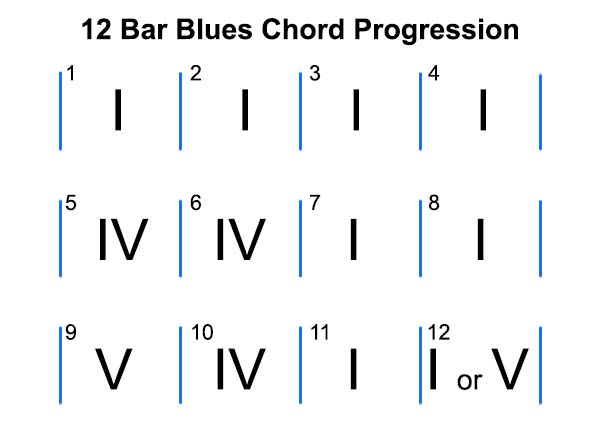
The Basic Blues Structure and Chords
The standard 12-bar blues progression divides 12 measures into three distinct 4-bar phrases:
Bars 1–4: I chord (4 measures)
Bars 5–6: IV chord (2 measures)
Bars 7–8: I chord (2 measures)
Bar 9: V chord (1 measure)
Bar 10: IV chord (1 measure)
Bars 11–12: I chord (2 measures, often ending with a V turnaround in bar 12)
Each harmony functions as a dominant seventh chord, establishing the signature blues tonality. These dominant qualities (I7, IV7, and V7) blend major triads with minor sevenths to produce the distinctive blues sound.
Understanding the I-IV-V Chord Relationship
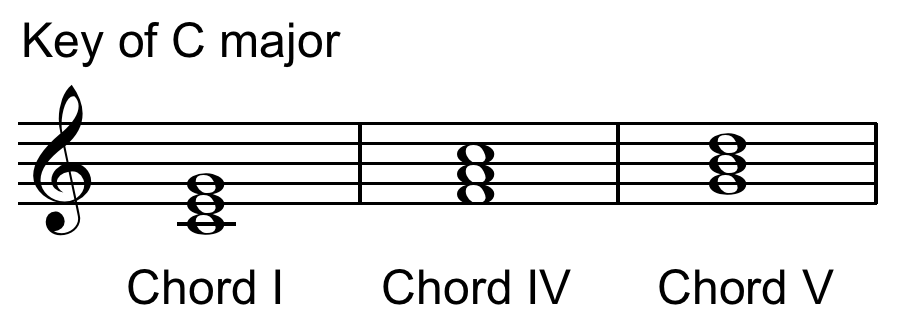
The I-IV-V chord relationship creates powerful harmonic momentum through predictable interval relationships. In the key of C major, these chords are C7 (I), F7 (IV), and G7 (V), built on the first, fourth, and fifth scale degrees.
Harmonic movement drives this relationship: the IV chord introduces contrast by departing from the tonic, while the V chord generates maximum tension that resolves naturally back to the I chord. Dominant seventh chords feature a flatted seventh interval (such as Bb in a C7 chord: C-E-G-Bb), producing the tension central to blues harmony.
Pianists count a steady “1-2-3-4” per measure to synchronize with ensemble players. While the 12-bar form remains the universal standard, the 16-bar blues variation extends the structure by adding 4 extra measures, typically lengthening the opening tonic section. Most musicians favor the 12-bar form for its concise balance and dynamic pacing.
How to Play 12-Bar Blues on Piano for Beginners
Beginner pianists should master fundamental chord shapes and steady rhythm before attempting advanced ornamentations. Focusing on relaxed hand posture, curved fingers, and smooth transitions ensures technical control and fluid voice leading across measure lines. Interactive tools like the best piano apps for kids can introduce basic concepts, but consistent daily practice on an acoustic or weighted 88-key digital piano remains essential for developing authentic touch.
Practicing chords individually develops muscle memory and hand independence. Physical relaxation and proper fingerings also serve as practical techniques for overcoming piano performance anxiety when playing in front of audiences.
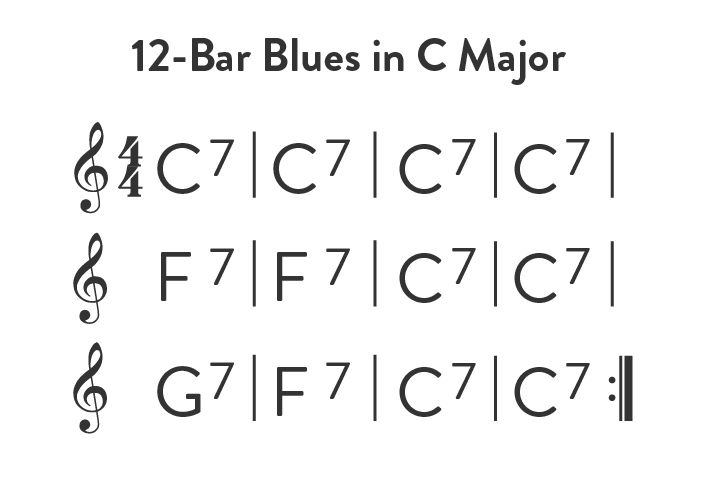
12-Bar Blues Piano Example in C Major
The 12-bar blues in C major uses three foundational dominant seventh chords:
C7: C-E-G-Bb (measures 1–4, 7–8, 11–12)
F7: F-A-C-Eb (measures 5–6, 10)
G7: G-B-D-F (measure 9)
Practice this progression at a slow tempo, maintaining a steady four-beat count per measure. Play solid block chords in the right hand while the left hand reinforces root notes or fifths on beats 1 and 3. This clean coordination builds the rhythmic stability needed for syncopated playing.
Playing the 12-Bar Blues in F
The 12-bar blues in F major offers comfortable piano fingerings and remains a preferred key for brass ensembles and vocalists:
F7: F-A-C-Eb
Bb7: Bb-D-F-Ab
C7: C-E-G-Bb
Mastering the key of F introduces flat key signatures and prepares pianists for ensemble jam sessions with horn sections.
Authentic Sounding Patterns for the Left Hand
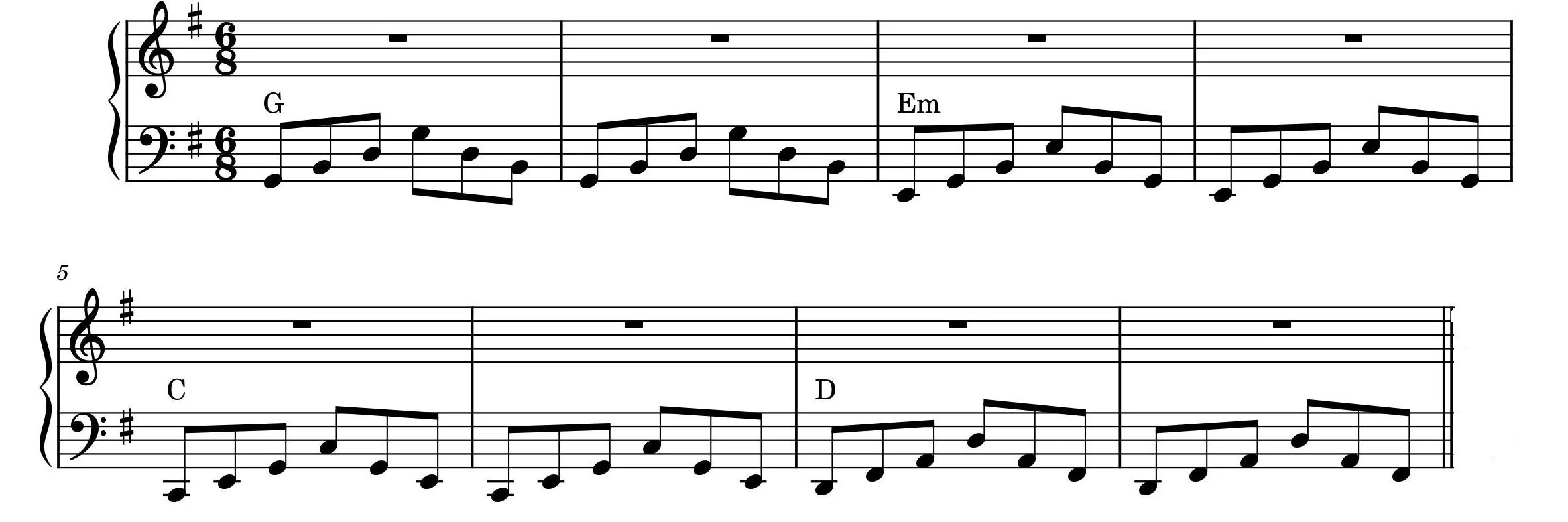
Authentic left-hand piano patterns supply rhythmic drive and harmonic clarity through walking bass lines, boogie-woogie figures, and stride accompaniment. Beginners should start with root-fifth alternating bass lines on beats 1 and 3 before advancing to quarter-note walking lines.
The classic “boom-chick” pattern pairs low bass notes on beats 1 and 3 with chord stabs on beats 2 and 4. Advanced players introduce chromatic passing tones between chord changes to connect harmonic movements smoothly.
Improvisation and Advanced Techniques
Improvisation over a 12-bar blues progression combines melodic scale choices, chord tone targeting, and expressive rhythmic phrasing. Pianists weave spontaneous solos by understanding how lead melodies interact with underlying dominant harmonies.
The 12 Bar Blues Cheatsheet for Improvisation
Essential improvisation techniques include four practical elements:
- Blues Scale Formula: 1-b3-4-#4-5-b7-8 (incorporating the expressive “blue note” #4/b5).
- Chord Tone Targeting: Landing on the 3rd or 7th of each changing chord to outline the harmony.
- Rhythmic Articulation: Applying swing eighth notes, syncopation, and triplet rhythms.
- Call-and-Response Phrasing: Structuring two-measure melodic questions answered by two-measure resolutions.
Practicing these components in isolated phrases establishes fluid soloing instincts.
Critical Keys in 12 Bar Blues Improv
Pianists must master blues progressions in multiple keys to ensure versatility across musical settings. The keys of F, Bb, and Eb major are critical for collaborating with brass and saxophone players, while C and G major remain essential for guitar-driven jam sessions.
Each key presents unique fingering contours. Developing proficiency in both flat and sharp keys expands your improvisational vocabulary across all 88 keys.
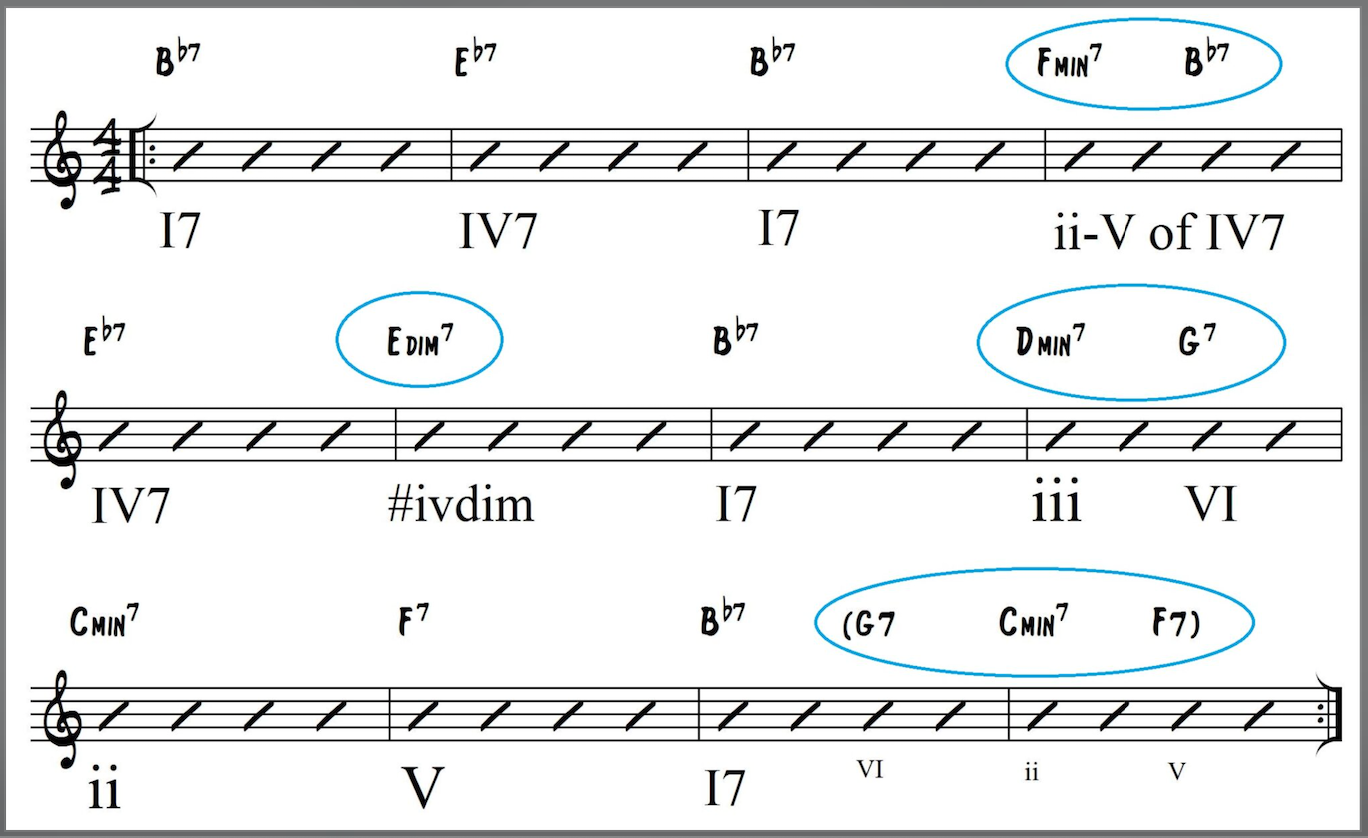
The Jazz Blues Progression Variation
The jazz blues variation enriches the traditional 12-bar progression by integrating ii-V substitutions, secondary dominants, and chromatic turnarounds:
Bars 1–2: I7 | IV7
Bars 3–4: I7 | I7
Bars 5–6: IV7 | #IVdim7
Bars 7–8: I7 | VI7
Bars 9–10: ii7 | V7
Bars 11–12: I7 VI7 | ii7 V7
These chord substitutions introduce sophisticated voice leading while honoring the fundamental blues architecture.
Famous Songs Using the 12-Bar Blues Structure
Countless iconic recordings demonstrate the versatility of the 12-bar blues progression across diverse genres. Classic blues standards include “Sweet Home Chicago,” “Stormy Monday,” and “Key to the Highway.”
Rock pioneers adapted this form in legendary tracks like “Johnny B. Goode,” “Hound Dog,” and “Good Golly Miss Molly.” In jazz, timeless pieces such as Charlie Parker’s “Billie’s Bounce” and Thelonious Monk’s “Straight, No Chaser” showcase the progression’s harmonic depth, reflecting the legacy of famous jazz pianists NYC has produced.
Where Did 12-Bar Blues Originate?
The 12-bar blues originated during the late 19th century among African American communities in the rural American South. Spirituals, field hollers, and work songs contributed the vocal inflections, call-and-response patterns, and blue notes that defined early rural blues.
Mississippi Delta pioneers like Robert Johnson, Charley Patton, and Son House codified the 12-bar form on acoustic guitar in the 1920s and 1930s. As musicians migrated to urban centers like Chicago, pianists adapted the progression into boogie-woogie, barrelhouse, and urban blues, creating a transformative foundation for American popular music.

Enhance Your Skills with Private Piano Lessons in New York City
PrivatePianoLessons provides personalized, 1-on-1 in-home piano instruction throughout all 5 boroughs of New York City: Manhattan, Brooklyn, Queens, The Bronx, and Staten Island. All lessons take place directly in your home on your own instrument, with $0 travel fees.
Our faculty consists of 48 degreed piano instructors with university music training, specializing in blues, jazz, and classical piano. Whether you are looking for an experienced piano instructor Brooklyn families rely on or lessons across Manhattan and Queens, our customized curriculum meets you at your skill level. Contact PrivatePianoLessons today to schedule your free 30-minute in-home evaluation.
Câu hỏi thường gặp (FAQs)
How many beats are in a 12-bar blues progression?
A standard 12-bar blues progression contains exactly 48 beats when played in 4/4 time, calculated by multiplying 12 measures by 4 beats per measure.
What is the difference between the 12-bar and 16-bar blues forms?
The difference between 12-bar and 16-bar blues forms lies in phrase length and measure count. The 12-bar blues uses three 4-measure phrases, whereas the 16-bar blues extends the form by 4 measures, typically by doubling the tonic (I) chord section.
What are the primary chords used in the 12-bar blues?
The primary chords in a 12-bar blues progression are the I (tonic), IV (subdominant), and V (dominant) chords, typically performed as dominant seventh chords (I7, IV7, and V7).
