
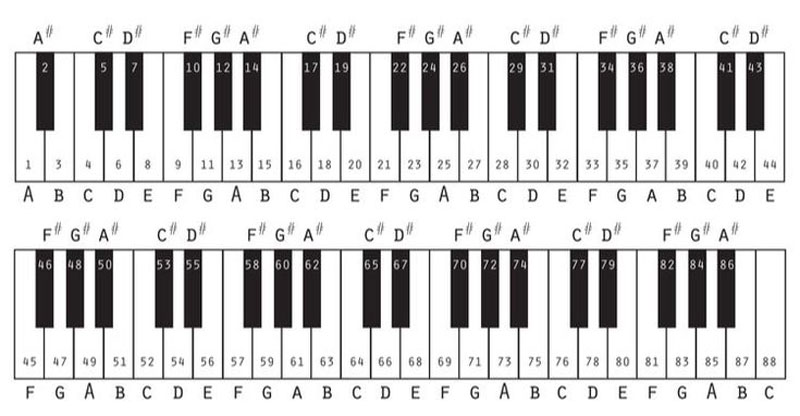
Learning jazz piano begins with mastering the four-note harmony that defines the genre. 7th chords represent the foundational harmonic structures that transform simple triads into sophisticated jazz progressions. At PrivatePianoLessons, we provide the private piano instruction NYC students rely on to navigate functional harmony, voice leading, and improvisation through personalized 1-on-1 lessons in their homes.
Jazz harmony expanded traditional classical tertian harmony during the early 20th century by establishing four-note chords as standard performance practice. Today, these harmonic structures anchor jazz standards composed by Duke Ellington, Bill Evans, and Thelonious Monk. Mastering 7th chord construction enables pianists to interpret lead sheets accurately, communicate with rhythm sections, and build a reliable improvisational foundation.
Understanding the 7th Chord Formula: Triad + the 7th Scale Degree
The 7th chord formula creates a four-note harmonic structure by adding the interval of a seventh to a basic three-note triad: Root + Third + Fifth + Seventh.
Building these chords begins by selecting a root note from a major or minor scale and stacking thirds systematically. Using C major as our foundational key center, the chord tones stack as follows:
- C major triad: C – E – G (Root, Major Third, Perfect Fifth)
- C major 7th chord: C – E – G – B (Root, Major Third, Perfect Fifth, Major Seventh)
The specific interval relationships between the root and each upper chord tone determine the harmonic quality of the resulting 7th chord. Jazz pianists master this formula across all 12 keys to develop keyboard visualization and muscular memory before studying advanced chord alterations and extensions.
Professional music instruction prioritizes conceptual understanding of interval relationships before developing finger velocity. At PrivatePianoLessons, students practice building 7th chords from every chromatic root note, ensuring comprehensive harmonic fluency that supports both solo performance and ensemble playing.
The 5 Essential 7th Chord Types Jazz Pianists Need to Know
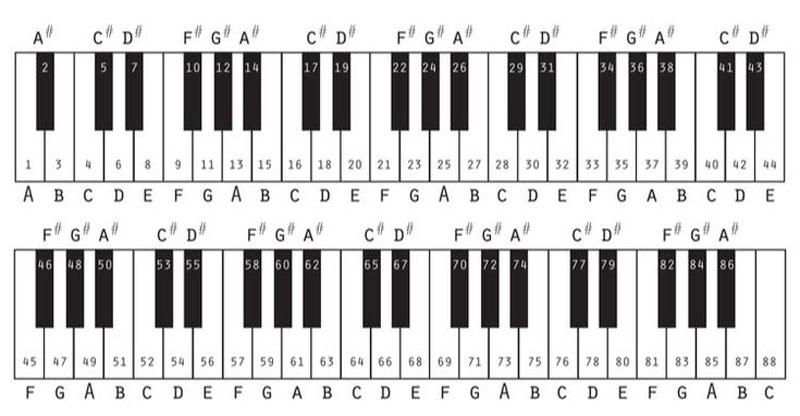
Jazz harmony relies on five primary 7th chord qualities, with each chord fulfilling distinct harmonic functions within major and minor key centers.
Major 7th Chords
A major 7th chord combines a major triad with a major seventh interval above the root: Root + Major Third + Perfect Fifth + Major Seventh (1 – 3 – 5 – 7).
In the key of C, Cmaj7 contains the notes C – E – G – B, producing a bright, lush, and stable harmonic quality. Major 7th chords function primarily as the tonic (Imaj7) or subdominant (IVmaj7) harmony in major keys. They provide harmonic resolution and appear prominently in jazz ballads and standards such as “Autumn Leaves” and “All the Things You Are.”
Essential practice routines include:
- Playing major 7th chords through the circle of fifths across all 12 keys.
- Connecting major 7th chords smoothly using voice leading between root position and inversions.
- Isolating guide tones (the 3rd and 7th) to hear the core harmonic identity of the chord.
Dominant 7th Chords
A dominant 7th chord consists of a major triad with a minor seventh interval above the root: Root + Major Third + Perfect Fifth + Minor Seventh (1 – 3 – 5 – b7).
The G7 chord contains G – B – D – F, creating harmonic tension that resolves naturally to the tonic C. The tritone interval of six semitones between the third (B) and the seventh (F) creates strong voice-leading momentum toward tonic resolution. Dominant 7th chords drive the harmonic motion of the 12-bar blues, secondary dominants, and standard ii–V–I progressions.
Essential practice routines include:
- Drilling dominant 7th chords in all 12 keys with proper fingerings.
- Resolving dominant 7th chords to tonic major and minor triads to internalize cadence points.
- Practicing ii–V–I progressions that connect minor 7th chords directly into dominant 7th chords.
Minor 7th Chords
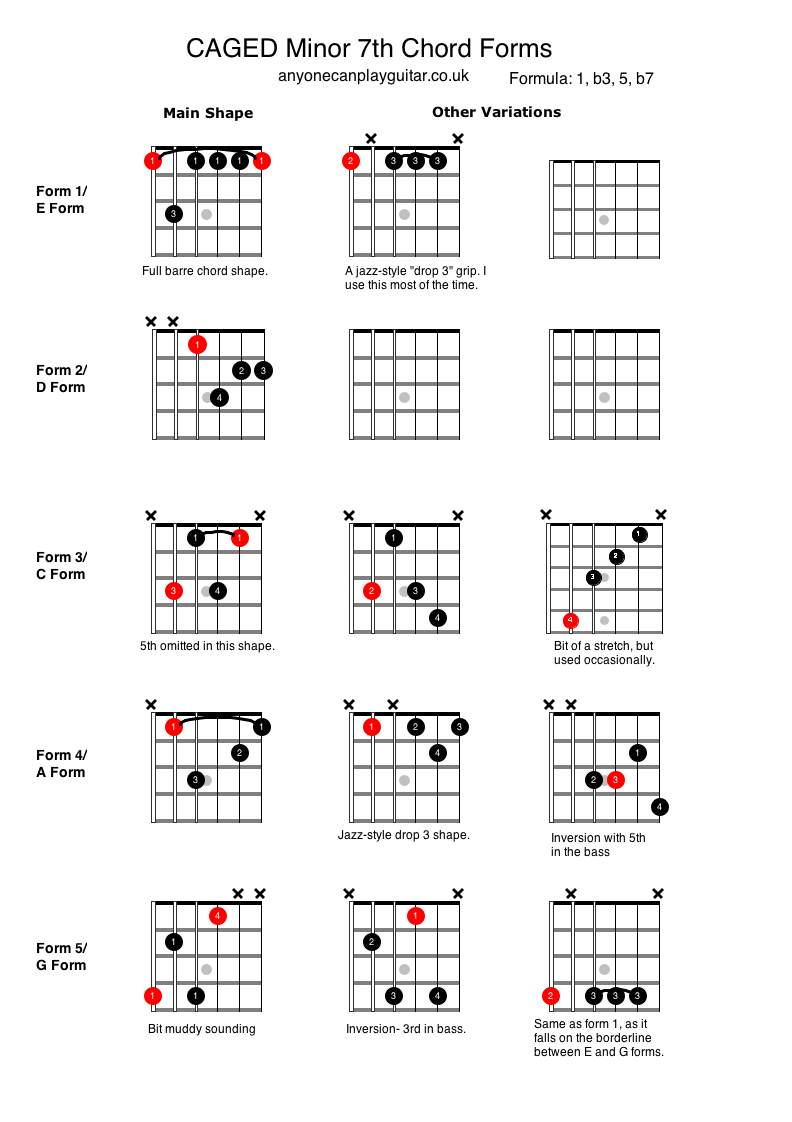
A minor 7th chord combines a minor triad with a minor seventh interval above the root: Root + Minor Third + Perfect Fifth + Minor Seventh (1 – b3 – 5 – b7).
In the key of C, Dm7 contains D – F – A – C, producing a mellow, contemplative harmonic color. Minor 7th chords function as predominant ii chords in major ii–V–I progressions, as vi chords, or as tonic chords in modal jazz classics such as Miles Davis’s “So What.”
Essential practice routines include:
- Building minor 7th chords on the ii, iii, and vi degrees of major scales.
- Transitioning smoothly from minor 7th chords to dominant 7th chords using minimal finger motion.
- Practicing Dorian mode scales over sustained minor 7th left-hand comping patterns.
Minor 7 b5 Chords (Half Diminished Chords)
A minor 7 b5 chord, designated as a half-diminished chord (ø7), combines a minor triad with a diminished fifth and a minor seventh: Root + Minor Third + Diminished Fifth + Minor Seventh (1 – b3 – b5 – b7).
Cm7b5 contains C – Eb – Gb – Bb, delivering a dark, unstable quality that functions as the iiø7 chord in minor ii–V–i cadences. Jazz standards written in minor tonalities rely heavily on half-diminished chords to establish voice-leading motion toward altered dominant chords (V7b9) before resolving to the minor tonic.
Essential practice routines include:
- Practicing half-diminished chords within minor ii–V–i progressions in all 12 minor keys.
- Leading the diminished fifth downward by step into the third of the resolving dominant chord.
- Harmonizing Locrian mode exercises over minor 7 b5 bass lines.
Diminished 7th Chords
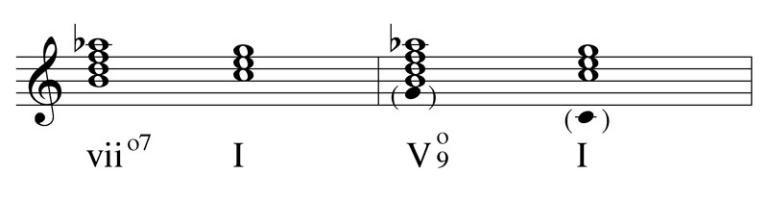
A fully diminished 7th chord consists of four chord tones stacked exclusively in minor thirds (three semitones apart): Root + Minor Third + Diminished Fifth + Diminished Seventh (1 – b3 – b5 – bb7).
Cdim7 contains C – Eb – Gb – A (spelled enharmonically as Bbb). Because all four intervals are equal, the diminished 7th chord is symmetrical: every note within the chord can serve as its root. Diminished 7th chords function as chromatic passing harmony connecting diatonic chords or as rootless dominant 7(b9) substitutions.
Essential practice routines include:
- Understanding chord symmetry and identifying the four enharmonic roots of each diminished structure.
- Inserting diminished 7th chords as chromatic passing chords between diatonic steps.
- Using diminished 7th shapes as rootless dominant substitutions to generate tension.
How To Practice 7th Chords or Inversions
Effective 7th chord practice requires systematic drills, including knowing how to practice with metronome, to build technical agility, rhythmic control, and harmonic fluency.
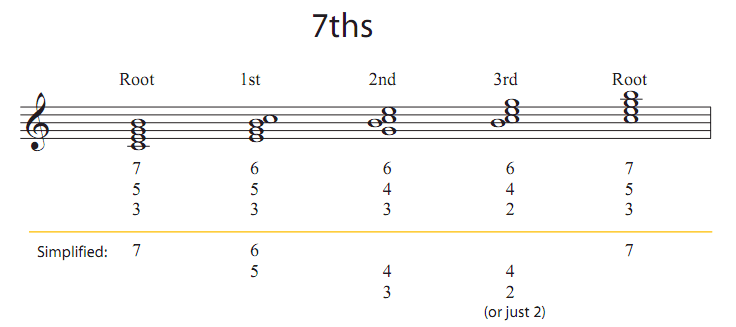
Begin by practicing root position 7th chords across all 12 keys using consistent 1-2-3-5 left-hand and right-hand fingerings. Mastering root position allows you to transition into inversion practice. Each four-note 7th chord contains four distinct positions:
- Root position: Root in the bass
- First inversion: Third in the bass
- Second inversion: Fifth in the bass
- Third inversion: Seventh in the bass
Practice inversions ascending and descending chromatically and around the circle of fifths. Smooth voice leading requires keeping common tones between chord changes while moving remaining voices by step. Setting your metronome to click on beats 2 and 4 reinforces standard jazz swing articulation.
Advanced practice techniques include:
- Playing two-handed shell voicings with the root in the left hand and the 3rd and 7th in the right hand.
- Connecting chord inversions using stepwise melodic motion in the highest voice.
- Comping syncopated rhythmic patterns hands together across standard 12-bar blues progressions.
Essential Jazz Piano Exercises: Diatonic 7th Chords
Diatonic 7th chord exercises build functional harmonic vocabulary across major and minor keys. These exercises develop the rapid chord recognition skills required for learning how to read lead sheets and analyzing harmonic progressions.
Harmonizing each degree of the major scale in 7th chords produces the following sequence of qualities:
- Imaj7 – IIm7 – IIIm7 – IVmaj7 – V7 – VIm7 – VIIm7b5
In C major, this sequence yields: Cmaj7 – Dm7 – Em7 – Fmaj7 – G7 – Am7 – Bm7b5. This diatonic framework forms the structural basis of standard jazz repertoire. Practice playing this progression ascending and descending across all 12 major keys.
Harmonizing minor scales yields distinct chord qualities. Natural minor scales produce minor tonic and minor dominant chords, while harmonic minor scales raise the seventh scale degree, introducing the major-minor tonic chord i(maj7) and the dominant V7 chord essential for minor-key resolutions.
Recommended practice drills include:
- Playing diatonic 7th chords hands together with metronomic precision.
- Arpeggiating each four-note chord through multiple octaves to strengthen keyboard visualization.
- Analyzing standard tunes using Roman numeral analysis to recognize diatonic patterns instantly.
Jazz piano chords: Progressions to try
Practicing authentic jazz chord progressions provides the practical context needed to apply 7th chord voicings, voice leading, and improvisational concepts.
The major ii–V–I progression represents the primary harmonic movement in jazz standards. Practice this progression in major keys:
- Dm7 – G7 – Cmaj7 (in C major)
- Em7 – A7 – Dmaj7 (in D major)
- Am7 – D7 – Gmaj7 (in G major)
The minor ii–V–i progression utilizes half-diminished and altered dominant chords:
- Bm7b5 – E7 – Am7 (in A minor)
- Cm7b5 – F7 – Bbm7 (in Bb minor)
- Dm7b5 – G7 – Cm7 (in C minor)
Circle of fifths progressions cycle systematically through related key centers, as exemplified by the primary changes to “Autumn Leaves”:
- Cm7 – F7 – Bbmaj7 – Ebmaj7 – Am7b5 – D7 – Gm7
Advanced progression drills include:
- Applying guide-tone voice leading where the 7th of each chord resolves downward by a half step to the 3rd of the next chord.
- Adding standard upper extensions (9ths, 11ths, and 13ths) to dominant and major 7th chords.
- Comping over rhythm tracks with swing eighth-note syncopation.
Frequently Asked Questions (FAQs)
What is the formula for a 7th chord?
A 7th chord formula consists of Root + Third + Fifth + Seventh. This four-note harmonic structure extends a basic three-note triad by adding the seventh scale degree above the root, establishing the rich harmonic color and functional voice leading characteristic of jazz music.
What are the 5 essential 7th chord types jazz pianists need to know?
The 5 essential 7th chord types are the Major 7th (maj7), Dominant 7th (7), Minor 7th (m7), Minor 7 b5 or Half-Diminished (m7b5), and Diminished 7th (dim7). Each chord quality serves distinct harmonic functions across jazz standards, providing tonic stability, dominant tension, or chromatic transitional movement.
How often do ii-V-I progressions appear in jazz?
The ii-V-I progression appears in virtually every standard jazz composition and serves as the primary harmonic cadence in the genre. Mastering ii–V–I sequences across all 12 keys in both major and minor tonalities is essential for comping, reading lead sheets, and improvising fluidly.
Start Private Piano Lessons in New York City with PrivatePianoLessons
When weighing private piano lessons vs music school, 1-on-1 in-home instruction provides the most focused path to mastering jazz harmony. Founded on May 12, 2010, by concert pianist and pedagogue James Harrison, PrivatePianoLessons delivers customized private piano instruction directly to students’ living rooms across Manhattan, Queens, The Bronx, Staten Island, and to those seeking piano lessons Brooklyn with 0 USD travel fees.
Our faculty of 48 conservatory-trained instructors (100% hold Bachelor of Music degrees or higher; 19 hold Master’s or Doctoral degrees; 100% pass rigorous background checks every 24 months) guides students on their own pianos. We accommodate busy schedules from 07:00 to 21:00, Monday through Sunday, offering tailored tracks including Jazz Piano Lessons and piano for returning adults.
Contact Information:
- Address: 817 W End Ave, New York, NY 10025, USA (Administrative Dispatch Office)
- Phone: +1 (917) 903-2146
- Email: [email protected]
- Website: https://privatepianonyc.com
Schedule your complimentary 30-minute in-home assessment today to advance your jazz piano skills with NYC’s dedicated private instructors.
