

Few piano works capture the human imagination like Ludwig van Beethoven’s Piano Sonata No. 14 in C-sharp Minor, universally known as the “Moonlight” Sonata. While the hypnotic triplets of the opening Adagio Sostenuto are instantly recognizable, this masterpiece offers a depth that extends far beyond its famous first movement. In this complete analysis guide, we journey through the history, revolutionary structure, and emotional landscape of Op. 27 No. 2—from the delicate “flower” of the Allegretto to the stormy virtuosity of the Presto Agitato.
Whether you are a pianist looking for performance tips or a music lover seeking to understand the tonal relationships within this “Sonata Quasi Una Fantasia,” discover the enduring magic behind one of the most significant works in piano literature.
Introduction to Piano Sonata No. 14 in C-sharp Minor “Moonlight”
Beethoven’s Piano Sonata No. 14 in C-sharp minor, Op. 27 No. 2, composed between 1801 and 1802, stands as a transformative monument in classical piano literature. The work fundamentally reshaped the structural conventions of the keyboard sonata at the threshold of the Romantic era.
This composition demonstrates Beethoven’s mastery of emotional expression through innovative harmonic color, unconventional formal architecture, and dramatic thematic transformation. For pianists striving to navigate these intricate technical and interpretive demands, taking private piano lessons in NYC provides tailored pedagogical guidance directly at the instrument.
Historical Context and Inspiration
Beethoven composed this sonata during a turbulent personal crisis marked by his deteriorating hearing and deep emotional vulnerability. In 1801, as his progressive hearing loss worsened, Beethoven dedicated the work to his 17-year-old pupil, Countess Giulietta Guicciardi, with whom he had fallen deeply in love.
Rigid social class differences precluded marriage, leaving the composer heartbroken during this fertile creative period. This emotional anguish catalyzed his transition from the high Classical aesthetic into his heroic middle period, imbuing the sonata with unprecedented expressive intensity.
Origin of “Moonlight” Sonata Name
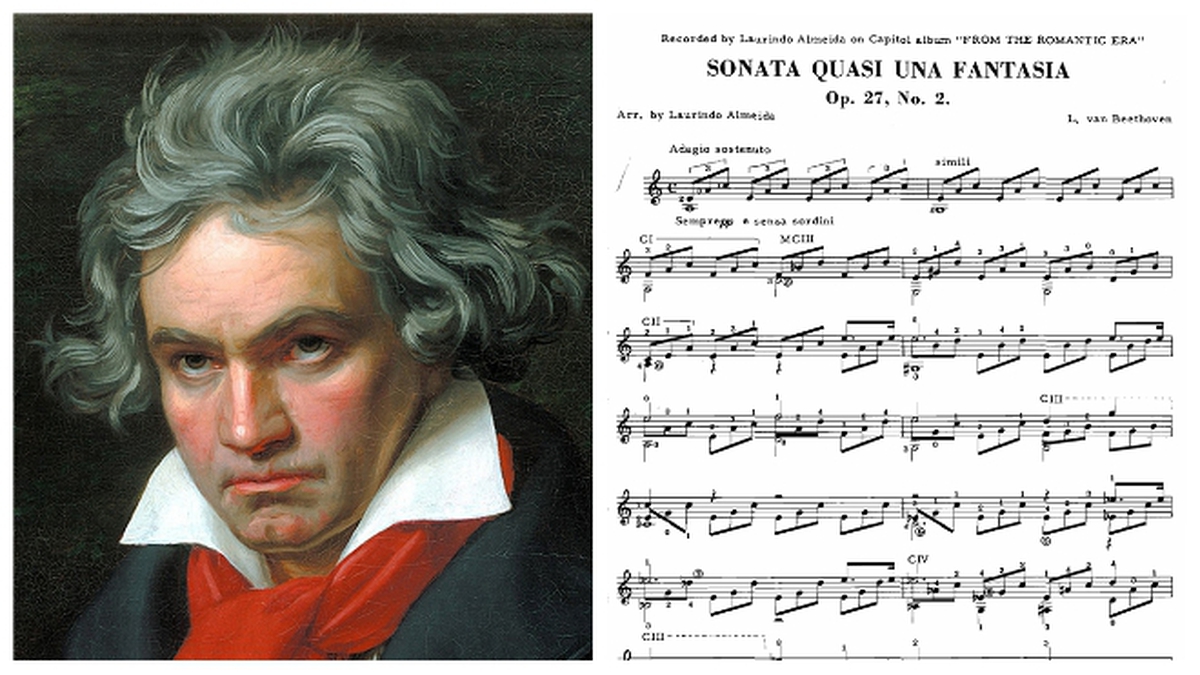
The famous “Moonlight” moniker was coined in 1832 by German poet and music critic Ludwig Rellstab, five years after Beethoven’s death. Rellstab compared the fluid nocturnal character of the first movement to a boat drifting across Lake Lucerne under the shimmering night sky.
Beethoven originally titled this work “Sonata quasi una fantasia” (Sonata in the manner of a fantasy), emphasizing his deliberate departure from traditional classical sonata conventions. The composer’s original designation highlights the piece’s organic freedom and revolutionary formal design.
General Information and Significance in Piano Literature
Piano Sonata No. 14 represents a pivotal watershed in keyboard literature, uniting Classical balance with emerging Romantic expression. The work comprises three contrasting movements spanning approximately 15 minutes in total performance duration.
Technical demands range from subtle thumb voicing and delicate pedaling in the first movement to virtuosic arpeggiated passage work in the finale. While mastering classical repertoire requires a strong foundation in music theory and reading skills, modern genres often require students to learn how to read lead sheets. The sonata remains central to advanced concert repertoire and academic conservatory study worldwide.
Overall Structure: Sonata Quasi Una Fantasia
Beethoven subverted standard three-movement sonata conventions by designating Op. 27 No. 2 as a “Sonata quasi una fantasia.” This title reflects a continuous psychological narrative wherein traditional formal boundaries dissolve into fluid, cyclic expression.
Breaking Traditional Classical Sonata Mold
Beethoven revolutionized sonata form by placing a contemplative slow movement first, completely inverting classical expectations. Classical sonatas typically opened with an energetic allegro in sonata-allegro form, followed by a lyrical slow movement, and concluded with a fast finale.
This structural innovation creates immediate emotional intimacy, drawing listeners into deep reflection before unleashing a dramatic climax. The deliberate progression from Adagio sostenuto through Allegretto to Presto agitato builds cumulative psychological tension across the entire work.
Tonal Relationships Between Movements
The three movements explore related keys that reinforce the sonata’s thematic unity and emotional trajectory:
- First Movement: C-sharp minor (the sombre, introspective tonic home key)
- Second Movement: D-flat major (the enharmonic parallel major of C-sharp, functioning as a lyrical submediant respite)
- Third Movement: C-sharp minor (a return to the home key with heightened dramatic fury)
This tonal architecture creates cyclic coherence while providing harmonic variety. The brief major-key oasis of the central movement makes the finale’s minor-key passion significantly more striking.
Analysis of First Movement: Adagio Sostenuto
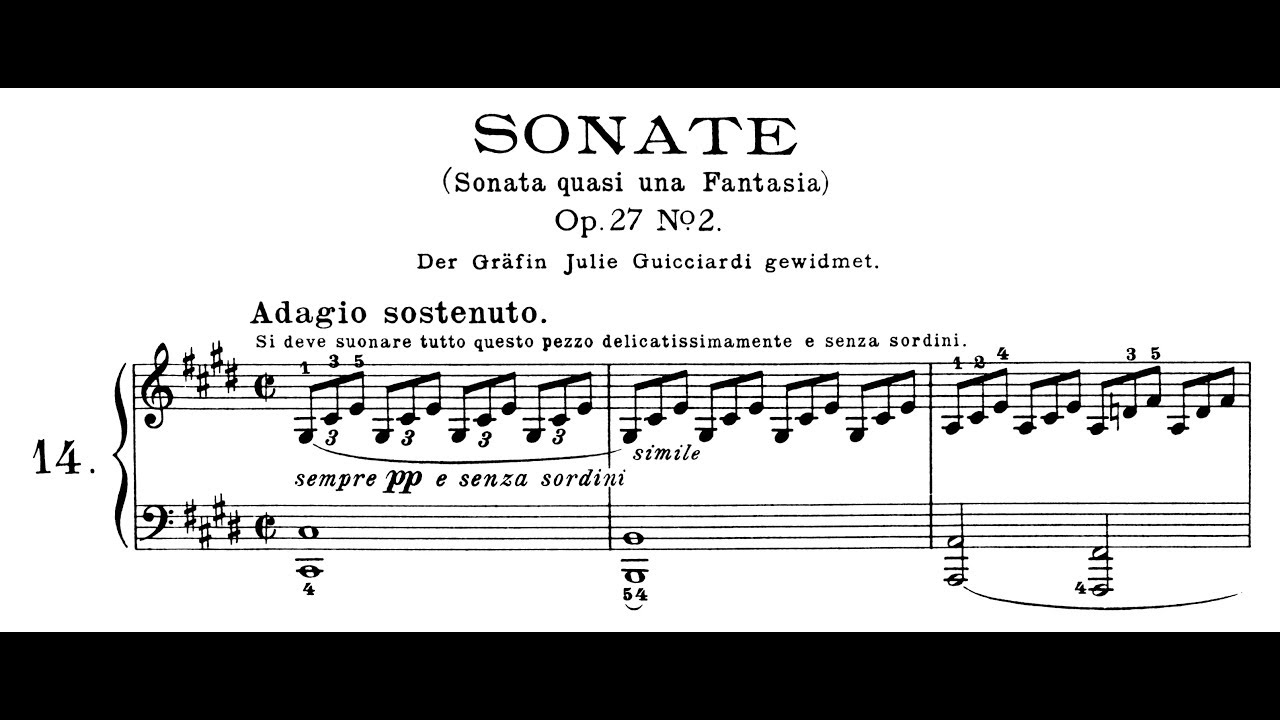
The first movement, marked Adagio sostenuto, is a 69-measure masterpiece of quiet introspection and atmospheric polyphony. Rather than presenting contrasting themes in standard sonata form, Beethoven constructs a continuous, grief-laden meditation.
Structure, Form, and A Unique Opening
The opening movement employs a modified, highly compressed sonata form without an explicit contrasting secondary theme. Beethoven replaces conventional thematic conflict with continuous organic variation over a compact ternary framework.
The movement’s design encompasses an exposition (measures 1–27), an unstable developmental middle section (measures 28–54), and a haunting recapitulation (measures 55–69). This structural conciseness concentrates immense emotional gravity into minimal physical duration.
The Hypnotic Rhythmic Ostinato (Triplets)
A continuous stream of right-hand broken-chord triplets forms the movement’s rhythmic foundation. This hypnotic ostinato pattern persists across all 69 measures, generating steady forward momentum while supporting the melodic line above.
Executing these triplets requires precise finger independence and careful pedaling to maintain clarity. The central technical challenge involves sustaining a singing cantabile melody while keeping the accompanying triplet figures whisper-soft.
Melody and Harmonic Progression
A famous dotted-rhythm melody emerges in measure 5, floating serenely above the triplet accompaniment and resonant bass octaves. Beethoven constructs this melody from compact motivic cells that develop through sequence and subtle chromatic inflection.
Harmonically, the movement explores profound emotional depths through specific compositional devices:
- Extensive use of diminished chords to generate poignant harmonic tension
- Striking Neapolitan sixth chords (D major in the context of C-sharp minor) that inject sudden pathos
- Chromatic bass voice leading that foreshadows nineteenth-century Romantic harmony
- Secondary dominants that enrich modulations to the relative major (E major) and subdominant (F-sharp minor)
Technical Details and Expressive Challenges
Performers face several demanding technical and acoustic challenges in this movement:
- Balancing three distinct textural layers: deep bass octaves, quiet inner triplets, and a singing soprano melody
- Achieving seamless legato phrasing in the melody while controlling rhythmic consistency in the accompaniment
- Calibrating subtle dynamic shading within a sustained pianissimo dynamic range
- Using the sustaining pedal to create atmospheric resonance without blurring harmonic transitions
Expressive interpretation requires immense restraint, avoiding theatrical sentimentality while honoring deep tragic pathos. Pianists managing physical limitations, such as finding beneficial piano exercises for arthritis, can maintain comfort through relaxed wrist circularity and arm-weight mechanics during these extended quiet passages.
Analysis of Second Movement: Allegretto
The second movement, marked Allegretto, provides a brief, graceful interlude between the sonata’s tragic opening and tempestuous finale. Lasting barely two minutes, this movement balances the work’s profound emotional extremes.
A Flower Between Two Chasms: Musical Character
Franz Liszt famously described this charming movement as “a flower between two chasms,” capturing its role as a delicate bridge between two dark, intense movements. Cast in the bright, enharmonic key of D-flat major, the movement evokes an aristocratic minuet.
The music features crisp syncopations, balanced four-measure phrase structures, and playful dynamic contrasts. Its lighthearted character offers a necessary psychological reprieve before the gathering storm of the finale.
Structural Breakdown: Scherzo and Trio Form
The movement follows a clear Scherzo and Trio structure in ternary form:
- Scherzo Section (Measures 1–24): Presents an elegant, lilting primary theme with buoyant off-beat accents in D-flat major
- Trio Section (Measures 25–48): Introduces sustained chordal harmonies and warm bass motion with contrasting rhythmic weight
- Scherzo Reprise (Measures 49–72): Returns to the opening material da capo, concluding cleanly without a coda
This pristine formal clarity contrasts deliberately with the structural ambiguity of the outer movements.
Role of Allegretto in Sonata
Positioned strategically between two minor-key masterworks, this brief major-key interlude fulfills vital musical functions:
- Provides emotional respite from relentless psychological tension
- Creates tonal variety through an enharmonic major-key relationship
- Offers technical relief from the demanding textures of the outer movements
- Maintains forward momentum toward the sonata’s dramatic conclusion
Analysis of the Third Movement: Presto Agitato
The finale, marked Presto agitato, is a breathtaking torrent of virtuosity, passion, and structural brilliance. Functioning as the true dramatic center of the sonata, this movement unleashes the emotional tension accumulated over the preceding movements.
Sonata Form: Exposition, Development, Recapitulation
The finale adopts full sonata-allegro form characterized by furious kinetic momentum. The exposition introduces a fiery primary theme composed of rising arpeggiated figures culminating in sharp, staccato accents, followed by an impassioned, lyrical secondary theme in G-sharp minor.
The development section (measures 103–158) manipulates these thematic components through intensive procedures:
- Thematic fragmentation and sharp sequential modulations through distant harmonic regions
- Contrapuntal layering of opening arpeggios against percussive chordal responses
- Violent dynamic fluctuations between sudden piano and explosive fortissimo accents
- Relentless Alberti-style bass figurations driving rhythmic momentum
The Dramatic Coda and Emotional Intensity
The extended coda (measures 158–200) functions as a second development and the dramatic peak of the entire sonata. Beethoven introduces sweeping chromatic cascades, frantic broken octaves, and thunderous cadential chords.
A brief improvisatory adagio interlude halts the frantic momentum before two final, explosive arpeggios plunge into a defiant C-sharp minor cadence. This coda demands total emotional and physical conviction from the performer.
Technical Demands and Virtuosity
Mastering the finale requires an elite level of technical facility:
- High-velocity arpeggios requiring rapid, tension-free thumb crossings
- Crisp staccato octaves demanding flexible wrists and forearm stamina
- Rapid tremolos and Alberti accompaniments requiring complete hand independence
- Accurate dynamic control during sudden subito piano and sforzando transitions
- Sustained physical endurance to project virtuosic velocity across four continuous minutes
These formidable demands make the movement suitable for advanced pianists with solid technical foundations.
Performance Tips and Practice Suggestions
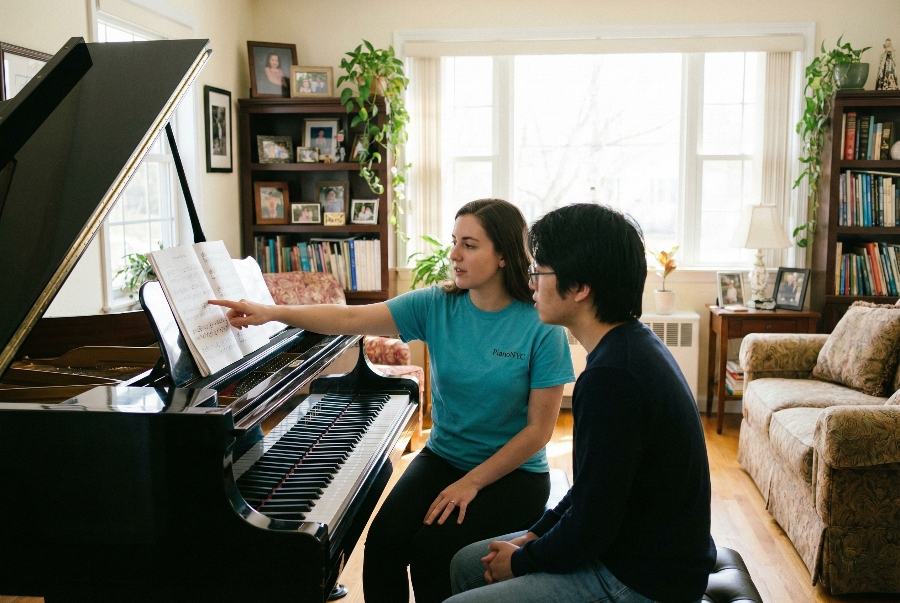
Interpreting Beethoven’s Op. 27 No. 2 successfully requires thoughtful structural awareness, meticulous technical preparation, and disciplined practice habits. Establishing regular practice sessions and knowing how to find time to practice piano ensures steady progress through these complex demands.
Navigating Tempo and Dynamics Choices
Tempo choices must reflect the structural unity of the sonata. The opening Adagio sostenuto should flow naturally without dragging, keeping the quarter-note pulse steady so the musical architecture remains intact.
Dynamic contrasts require careful calibration on modern concert grands. Modern instruments possess greater resonance than Beethoven’s 1801 fortepianos; consequently, pianists must avoid heavy pedaling in the Adagio and prevent harsh percussiveness during the fortissimo outbursts of the Presto agitato.
Overcoming Technical Difficulties in Each Movement
Targeted practice strategies resolve the core technical challenges of each movement:
First Movement Practice Strategies:
- Practice the soprano melody and bass line together without the inner triplets to internalize phrasing and harmonic direction
- Rehearse inner triplets independently with rhythmic variations to ensure evenness and a feather-light touch
- Implement subtle flutter-pedaling techniques on modern pianos to maintain harmonic cleanliness
- Refine fifth-finger cantabile voicing using gentle arm-weight release
Second Movement Considerations:
- Maintain strict, dance-like tempo stability without excessive rubato
- Articulate slurs and staccatos crisply to highlight Classical elegance
- Ensure clean voicing balance between the syncopated right hand and steady left-hand accompaniment
- Execute smooth, unhurried transitions into and out of the Trio section
Third Movement Mastery:
- Isolate upward arpeggios using rhythmic variations (dotted rhythms and reverse accents) at slow tempos
- Maintain a supple wrist to absorb shock during rapid octave passages and prevent forearm tension
- Practice hands separately with a metronome to establish absolute rhythmic precision
- Build stamina gradually by running thematic sections in pairs before attempting uninterrupted run-throughs
Mastering the Sonata with PrivatePianoLessons in New York City
PrivatePianoLessons provides one-on-one, in-home piano instruction across all five boroughs of New York City: Manhattan, Brooklyn, Queens, The Bronx, and Staten Island. Coordinated from our headquarters at 817 W End Ave, New York, NY 10025, our faculty consists of conservatory-trained pianists holding degrees from institutions such as The Juilliard School and Manhattan School of Music. While advanced masterworks like Op. 27 No. 2 require rigorous coaching, our teachers also understand how to make piano fun for kids and beginners across our structured 8-level curriculum.
Our tailored classical coaching emphasizes:
- Personalized technical regimens targeting touch, voicing, and pedal clarity directly on your home piano
- Historical performance practice informed by scholarly research and authentic Classical stylistic conventions
- Rigorous piano recital preparation, including audition simulations and competition coaching for our biannual NYC recitals
- In-depth structural and harmonic analysis that transforms interpretive understanding into confident stage performance
Conclusion: The Enduring Magic of Beethoven’s Op. 27 No. 2
Beethoven’s “Moonlight” Sonata endures as one of the most compelling achievements in the Western keyboard canon. Its revolutionary inversion of sonata form, haunting harmonic language, and explosive dramatic narrative continue to captivate pianists and audiences over two centuries after its creation.
By guiding performers from intimate, meditative stillness through elegant Classical grace to tempestuous virtuosic fury, Op. 27 No. 2 bridges Classical balance with the uninhibited passion of the Romantic era. Studying this masterpiece deepens a pianist’s expressive range and refines essential physical technique.
For students working with PrivatePianoLessons throughout New York City, mastering this sonata marks a major milestone in artistic growth. Whether studying the poetic lyricism of the opening Adagio or conquering the virtuosic tempest of the Presto agitato, dedicated in-home coaching helps bring Beethoven’s timeless vision to life on your own instrument.

Frequently Asked Questions (FAQs)
What is the nickname of Beethoven’s Piano Sonata No. 14?
The universal nickname for Beethoven’s Piano Sonata No. 14 in C-sharp Minor, Op. 27 No. 2, is the “Moonlight” Sonata. German music critic and poet Ludwig Rellstab coined the moniker in 1832, five years after the composer’s death, comparing the first movement’s atmosphere to moonlight shining over Lake Lucerne in Switzerland.
Why is “Moonlight” Sonata considered revolutionary?
The “Moonlight” Sonata is considered revolutionary because Beethoven inverted traditional Classical sonata form by opening with a meditative, slow Adagio sostenuto instead of an energetic Allegro. Titled “Sonata quasi una fantasia”, the work abandons conventional structural expectations and channels cumulative emotional tension toward an explosive, virtuosic finale.
What key is the “Moonlight” Sonata in?
The “Moonlight” Sonata is composed primarily in the key of C-sharp minor. Its three movements follow an integrated cyclic tonal plan: the first movement opens in C-sharp minor, the second movement moves to its enharmonic parallel major key of D-flat major, and the third movement returns to C-sharp minor with heightened dramatic intensity.
