
Living in New York City requires optimizing residential floor space without compromising musical education. An 88-key weighted digital piano provides an authentic acoustic touch and tone while eliminating the physical footprint constraints, seasonal tuning expenses, and neighbor noise disputes common to Manhattan and Brooklyn apartments.
At PrivatePianoLessons, our private piano teachers NYC work with students practicing on digital instruments across all five boroughs. This guide presents professional instrument recommendations evaluated for compact apartment dimensions, key touch sensitivity, and daily home practice efficiency.
Why Choose Digital Pianos for NYC Apartment Living?
Digital pianos resolve the four primary logistical challenges of maintaining an instrument in a New York City apartment:
- Space Efficiency: Manhattan apartments average 80.5 m² (866 sq ft), requiring smart spatial planning. Digital pianos occupy 60% less floor space than acoustic uprights while providing a complete 88-key keyboard.
- Noise Control: Strict NYC residential quiet hours and shared apartment walls make acoustic instruments difficult to practice. Digital pianos feature dual headphone outputs and smooth volume sliders, enabling 24-hour practice without sound transmission.
- Zero Maintenance Costs: Digital pianos eliminate biannual acoustic tuning fees ($150–$300 per session in NYC), seasonal climate control expenses, and specialized moving logistics.
- Educational Versatility: Modern sound engines include precision metronomes, multi-track recording, and authentic instrument samples that assist student practice routines between private lessons.
Our teaching faculty evaluated 15 digital piano models in residential NYC apartments. These 6 instruments deliver reliable touch response and dynamic sound quality for dedicated students:
Best Overall for Experience: Yamaha Clavinova CLP-885
Dimensions: 145.5 cm W × 47.0 cm D × 102.1 cm H (57.3″ W × 18.5″ D × 40.2″ H)
Weight: 59.9 kg (132 lbs)
Price Range: $3,500–$4,000
The Yamaha Clavinova CLP-885 replicates the mechanical feedback and sound projection of a concert grand piano within a compact upright cabinet. Its GrandTouch weighted wooden keys feature synthetic ebony and ivory keytops that absorb moisture and promote finger stability during technical passages.
Key Features:
- Binaural acoustic sampling of the Yamaha CFX and Bösendorfer Imperial grand pianos
- Triple-sensor key detection system capturing delicate trills and dynamic gradations
- Built-in pedagogical exercises compatible with standard classical conservatory repertoire
- Smart Pianist app integration for score display and sound customization
Ideal for: Advanced students and adults studying classical piano repertoire in Manhattan who require authentic concert grand touch and dynamic control.
Best Slimline Design: Yamaha Arius YDP-145
Dimensions: 135.4 cm W × 41.4 cm D × 83.1 cm H (53.3″ W × 16.3″ D × 32.7″ H)
Weight: 37.6 kg (83 lbs)
Price Range: $800–$1,000
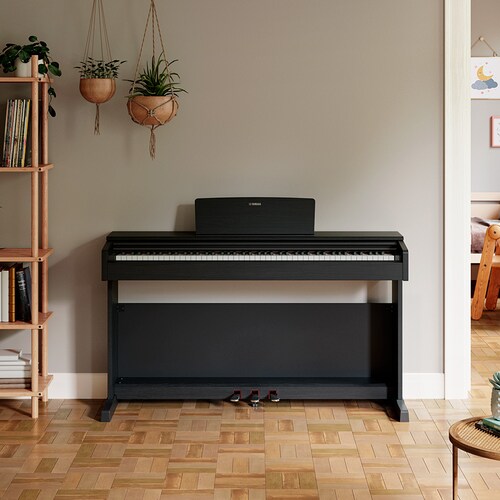
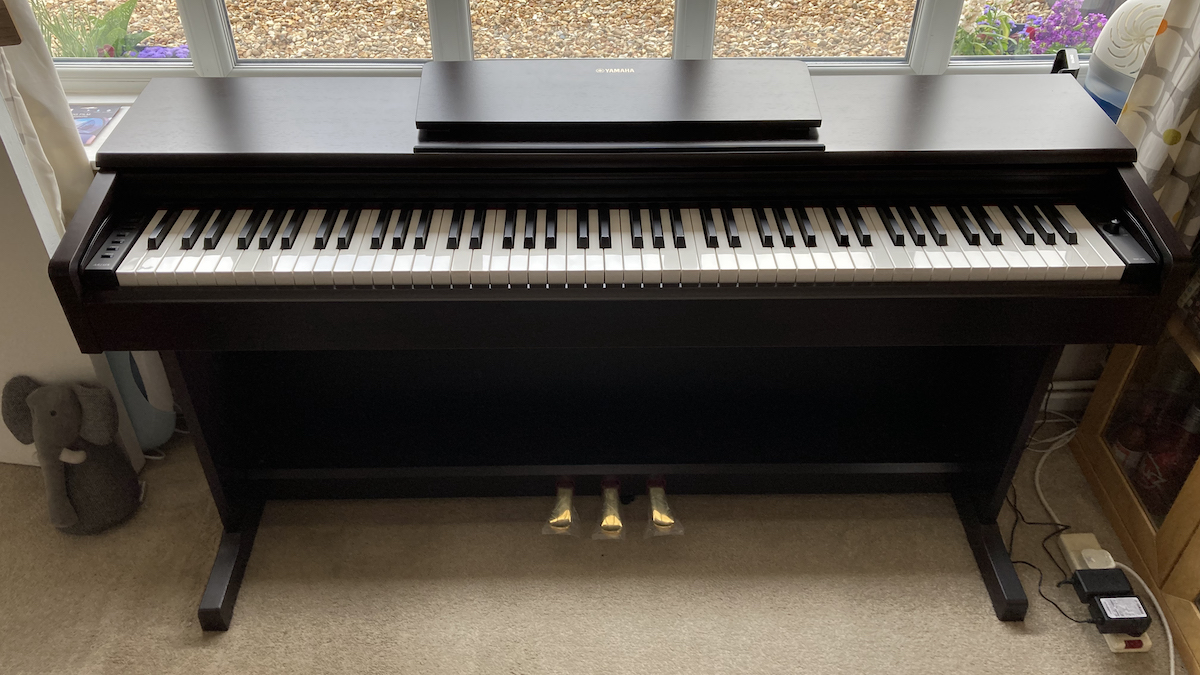
The Yamaha Arius YDP-145 integrates full 88-key functionality into a shallow cabinet designed for studio and one-bedroom apartments. The console footprint preserves room walkway clearance while providing an integrated key cover and three-pedal assembly.
Key Features:
- Graded Hammer Standard (GHS) action with heavier resistance in low registers and lighter touch in higher registers
- Yamaha CFX concert grand sound engine with Stereophonic Optimizer technology
- Dual and Duo keyboard split modes designed for side-by-side student-teacher lesson work
- Integrated wooden music rest and compact bench
Target audience: Beginner and intermediate students in Brooklyn and Queens apartments who need space-saving cabinetry without sacrificing foundational keyboard touch. This instrument is frequently recommended by virtually any piano instructor Brooklyn has to offer.
Best Compact and Portable: Casio Privia PX-S1100
Dimensions: 132.1 cm W × 23.1 cm D × 10.2 cm H (52.0″ W × 9.1″ D × 4.0″ H)
Weight: 11.3 kg (24.9 lbs)
Price Range: $600–$750
The Casio Privia PX-S1100 features a slim depth profile under 24 cm (9.5 inches), making it easy to store in a closet or under a bed in multi-purpose residential spaces.
Key Features:
- Smart Scaled Hammer Action keyboard with individual key scaling across all 88 keys
- 18 instrument voices with layer and split performance configurations
- Wireless Bluetooth audio and MIDI adapter included for mobile device integration
- Optional matching furniture stand (CS-68P) and triple-pedal unit (SP-34)
Recommended to: Young professionals and students in studio apartments who prioritize lightweight portability and flexible storage during apartment relocations.
Best for Contemporary Style: Casio PX-S7000
Dimensions: 132.1 cm W × 23.1 cm D × 10.2 cm H (52.0″ W × 9.1″ D × 4.0″ H)
Weight: 14.2 kg (31.3 lbs without stand)
Price Range: $1,200–$1,400
The Casio PX-S7000 pairs mid-century interior aesthetics with professional digital sound architecture, making it an attractive focal point in contemporary open-concept apartments.
Key Features:
- Smart Hybrid Hammer Action combining spruce wood construction with responsive digital key sensors
- 400 onboard voices including historic acoustic grands and vintage stage electric pianos
- Integrated microphone input with discrete vocal effects processing
- Spatial sound system with 4 independently powered speakers calibrated for room placement
Intended for: Jazz and contemporary piano students inspired by famous jazz pianists NYC is celebrated for, offering expressive voicing and modern style for urban spaces.
Best Budget-Friendly Option: Yamaha Piaggero NP-32 or Korg LP-380U
Yamaha Piaggero NP-32:
– Dimensions: 103.1 cm W × 26.4 cm D × 10.4 cm H (40.6″ W × 10.4″ D × 4.1″ H)
– Weight: 5.5 kg (12.1 lbs)
– Price: $180–$220
Korg LP-380U:
– Dimensions: 134.9 cm W × 34.5 cm D × 79.0 cm H (53.1″ W × 13.6″ D × 31.1″ H)
– Weight: 34.9 kg (77 lbs)
– Price: $700–$850
These two models serve distinct beginner budgets. The semi-weighted 76-key Yamaha NP-32 functions as a temporary entry tool for testing musical interest. For comprehensive technical development, PrivatePianoLessons recommends full 88-key weighted instruments such as the Korg LP-380U, which includes Real Weighted Hammer Action 3 (RH3) keys manufactured in Japan.
Suitable for: Adult beginners evaluating their long-term commitment or parents introducing young children to piano fundamentals before investing in a permanent weighted instrument.
Best for Advanced Players: Roland FP-E50
Dimensions: 134.6 cm W × 29.5 cm D × 14.0 cm H (53.0″ W × 11.6″ D × 5.5″ H)
Weight: 18.5 kg (40.7 lbs)
Price Range: $1,100–$1,300
The Roland FP-E50 delivers professional stage performance features within an apartment-friendly slab chassis, supporting technical fingerwork and harmonic voicing.
Key Features:
- SuperNATURAL Piano sound engine with authentic acoustic string and damper resonance
- PHA-4 Standard 88-key keyboard with escapement mechanism and ivory-feel key surfaces
- ZEN-Core sound generator providing synthesized leads, orchestral strings, and bass lines
- Interactive chord accompaniment tools supporting real-time arrangement practice
A great choice for: Pre-conservatory candidates, songwriting pianists, and working musicians preparing audition repertoire for New York City music programs.
Top Features to Look for in Apartment-Friendly Digital Pianos
Selecting an apartment-ready digital piano requires balancing room dimensions, acoustic fidelity, and neighbor-friendly volume management.
Compact Size and Space-Saving Harmony
Proper space planning ensures your digital piano integrates into your living area without obstructing daily room traffic:
- Footprint Optimization: Measure your room layout before purchasing. Maintain a minimum clear width of 91.4 cm (36 inches) for bench travel and 61.0 cm (24 inches) of knee clearance for pedal reach. Having piano pedals explained clarifies why correct posture and leg clearance are essential for foot-pedal mechanics.
- Vertical Clearance: Account for music desk height and reading angles. Standard console digital pianos measure 101.6–114.3 cm (40–45 inches) from the floor to the top of an open music rest.
- Cabinet Utility: Select models with sliding key lids, internal cable routing, or fold-flat music rests to preserve clean lines in multi-functional living areas.
Volume Control and Headphone Connectivity for Neighbors
Precise sound attenuation protects neighbor relationships in multi-unit buildings:
- Headphone Quality: Connect professional closed-back studio headphones, such as Audio-Technica ATH-M50x, Sony MDR-7506, or Sennheiser HD 280 Pro, to ensure clear dynamic fidelity during silent practice.
- Continuous Volume Sliders: Choose digital pianos with analog volume sliders rather than stepped push-buttons to fine-tune sound output to safe listening levels.
- Dual Headphone Ports: Verify that the instrument provides two 6.35 mm (1/4-inch) or 3.5 mm headphone jacks, enabling teacher and student to monitor audio simultaneously during in-home lessons.
Key Action and Realistic Sound Quality
Keyboard mechanics establish the finger strength and articulation required for repertoire progression:
- Weighted Hammer Action: Graded hammer action systems replicate the physical mechanical leverage of acoustic hammers, developing finger dexterity and joint alignment.
- Multi-Velocity Acoustic Sampling: Advanced sound engines record concert grand pianos at multiple dynamic layers (from pianissimo to fortissimo), responding accurately to varying finger attacks.
- Triple-Sensor Key Detection: Three mechanical sensors per key track rapid note repetitions without requiring the key to return to its resting position, supporting advanced classical repertoire.
How to Set Up Your Digital Piano in a Small Apartment
Establishing an ergonomic and acoustically isolated practice station enhances daily concentration and technical progress.
Matching a Digital Piano to Your Room’s Style
Positioning your instrument correctly protects electronic components and complements home decor:
- Finish Selection: Matte black finishes absorb glare in sunny rooms, while satin white cabinets reflect ambient light and brighten compact studio corners.
- Environmental Placement: Position digital pianos away from direct steam radiators, window drafts, and air conditioning vents to protect internal circuitry and wooden key cores.
- Dedicated Illumination: Position a focused LED desk lamp delivering 300–500 lux directly over your sheet music or tablet to prevent eye strain during evening practice.
What accessories do I need for my digital piano?
Equipping your instrument with supportive accessories improves postural stability and practice discipline:
Essential Hardware:
- Padded, height-adjustable piano bench ($80–$150) to position elbows level with the keyboard
- Full-size metal damper pedal supporting half-pedaling expression ($30–$60)
- Closed-back studio monitoring headphones ($100–$200) for silent practice
- Double-braced steel stand or manufacturer wooden console stand ($70–$160)
Practice Organization:
- Wall-mounted shelving units for method books and manuscript paper
- Under-bench storage compartments to stow cables and pedals
- Stable sheet music clips to secure loose scores
Skill Development Tools:
- Audible metronome or metronome smartphone application for rhythmic precision
- Audio recording device or tablet for weekly self-evaluation
- Practice journal or digital log to record weekly lesson assignments
Tips for Moving and Transporting Digital Pianos in NYC
Transporting a digital piano through New York City buildings requires careful planning:
- Elevator and Stairwell Measurement: Measure building elevator cab depth, door widths, and tight stairwell turns before ordering console models to confirm clear passage.
- Disassembly Protocol: Detach the keyboard chassis from its wooden stand before moving. Pack pedal assemblies, power adapters, and music rests in labeled boxes.
- Protective Packaging: Retain original factory packaging, styrofoam corners, and padded moving blankets to protect cabinet finishes during apartment relocations.
Enhancing Your Experience with Private Piano Lessons in New York City
Consistent instruction accelerates technical proficiency when paired with a reliable home digital piano.
The Importance of a Home Instrument for PrivatePianoLessons
Regular daily practice on an 88-key weighted instrument reinforces finger coordination and reading fluency faster than sporadic studio rehearsals:
- Structured Practice Habits: Immediate access to a home instrument enables daily 20–30 minute focused sessions, producing consistent muscle memory.
- Technical Continuity: Practicing on weighted keys preserves finger articulation between weekly lessons, helping students master complex repertoire and improvisational styles like a blues piano progression.
- Performance Confidence: Developing familiarity with consistent key depth and resistance builds confidence for studio recitals and practical exams.
Transitioning from Digital to Acoustic during Lessons
PrivatePianoLessons faculty guide students in translating digital practice skills to acoustic grand and upright pianos:
- Touch Weight Calibration: Instructors train students to adjust arm weight and finger release when performing on acoustic pianos with heavier escapement resistance.
- Acoustic Resonance Control: Lessons develop physical pedal control and listening skills to manage acoustic soundboard sustain and sympathetic string vibrations.
- Performance Preparation: Regular work on 88-key weighted digital instruments ensures seamless transitions to acoustic grand pianos during biannual recitals and conservatory evaluations.
Founded on May 12, 2010, by concert pianist James Harrison, PrivatePianoLessons provides personalized, 1-on-1 in-home piano instruction throughout Manhattan, Brooklyn, Queens, The Bronx, and Staten Island. Headquartered at 817 W End Ave, New York, NY 10025, our faculty of 48 degreed instructors—all holding a Bachelor of Music or higher, with 19 holding Master’s or Doctoral degrees—teaches students aged 4 and older across 7 specialized programs: Piano Lessons for Kids, Adult Piano Lessons, Piano Lessons for Seniors, Beginner Piano Lessons, Professional Coaching Lessons, Classical Piano Lessons, and Jazz Piano Lessons. Lessons operate from 07:00 to 21:00, Monday through Sunday, with $0 travel fees and an 8-level curriculum aligned with RCM and ABRSM standards. Contact us at +1 (917) 903-2146 or [email protected] to arrange your complimentary 30-minute in-home assessment.
Frequently Asked Questions (FAQ)
Can I use a digital piano in an apartment without disturbing my neighbors?
Yes, you can use a digital piano in an apartment without disturbing your neighbors by connecting closed-back headphones and adjusting volume output. Digital instruments produce sound through electronic tone generators rather than acoustic soundboards, eliminating airborne sound transmission and structural floor vibrations through apartment walls.
How do digital pianos compare to acoustic pianos in apartment use?
Digital pianos offer superior noise control, compact floor dimensions, and zero maintenance requirements compared to acoustic pianos for apartment living. While high-end acoustic pianos offer infinite acoustic dynamic nuances, modern 88-key weighted digital instruments deliver 85% to 90% of acoustic hammer feel at a fraction of the physical size, as analyzed in our comparison of digital vs acoustic piano features for home use.
How much should I spend on a digital piano for a beginner?
Beginners should budget $600 to $1,200 for a durable digital piano featuring 88 fully weighted keys and a sustain pedal. Instruments in this price range include graded hammer mechanisms and dynamic sound engines that support beginner through intermediate technical training for 5 to 7 years.
Should I order a digital piano online or buy in-store?
Testing a digital piano in-store allows you to evaluate keyboard resistance and speaker quality in person, while purchasing online offers broader model inventory and scheduled apartment delivery. Visiting local New York City music showrooms lets you test keybed actions directly before ordering.
