

Learning piano as an adult presents unique opportunities to connect directly with contemporary music. For those starting piano late in life, adult piano students develop technical keyboard skills more efficiently when practicing familiar pop melodies that align with their personal musical preferences and auditory familiarity.
Why Learning Pop Songs on Piano is Perfect for Beginners
Pop songs provide structured learning advantages for adult piano beginners because recognizable harmonic frameworks accelerate keyboard geography and muscle memory. Most popular arrangements feature cyclical 3-chord to 6-chord progressions based on foundational diatonic harmony, making them accessible entry points for technical and rhythmic coordination.
Adult learners benefit from melodic familiarity, which reinforces auditory self-correction and sustains practice consistency. Playing recognizable repertoire links theoretical understanding with tactile execution, establishing steady motivation during the initial learning curve.
The repetitive verse-chorus architecture in contemporary pop music allows beginners to master fundamental mechanics:
- Executing chord transitions, triad inversions, and ergonomic fingering shapes
- Maintaining rhythmic stability, metronomic pulse, and steady meter
- Developing bilateral hand independence between melody lines and bass accompaniments
- Refining expressive dynamics, legato touch, and damper pedal control
Top Best Pop Songs for Adults Beginners to Learn on the Piano
1. Let It Be – The Beatles
This Beatles standard is built on the classic I–V–vi–IV chord progression in C major: C, G, Am, and F. This sequence appears across hundreds of contemporary works, establishing an essential harmonic foundation for keyboard novices.
The piece trains steady quarter-note accompaniment in the left hand alongside syncopated vocal phrasing in the right hand. Adult beginners typically master the basic chord changes within 2 to 3 weeks of daily 20-minute practice sessions.
2. Hallelujah – Leonard Cohen
Leonard Cohen’s ballad utilizes a 6-chord vocabulary (C, Am, F, G, E7, and Em) arranged in a flowing 6/8 compound meter. The rolling rhythmic pulse develops steady subdivision without requiring rapid hand velocity.
The arrangement cultivates finger independence through broken arpeggiated patterns across both hands. Adult learners build harmonic voicing awareness and learn precise damper pedal timing to sustain sound without blurring chord changes.

3. All of Me – John Legend
John Legend’s piano ballad uses a slow tempo of approximately 63 BPM, giving beginners ample time to anticipate physical chord shifts. Beginner arrangements typically simplify the progression to Em, C, G, and D.
The composition introduces syncopated rhythm patterns and basic seventh-chord voicings common in modern R&B. Students develop solid rhythmic comping in the left hand while sustaining melodic clarity in the right.
4. Someone You Loved – Lewis Capaldi
This contemporary ballad relies on a 4-chord cyclical progression (C, G, Am, and F) set to a moderate tempo. The predictable harmonic rhythm allows beginner adults to focus on clean finger placement and wrist relaxation.
The repetitive left-hand pattern supports right-hand expressive dynamics and phrase shaping. Students learn how to control volume variations between sections without rushing the underlying tempo.
5. Perfect – Ed Sheeran
Ed Sheeran’s romantic hit translates acoustic guitar fingerpicking into flowing piano arpeggios using G, Em, C, and D. The recurring 12/8 ballad feel encourages relaxed forearm rotation and fluid wrist movements.
Adult beginners develop lateral hand movement across octaves and steady accompaniment pacing. The consistent structure simplifies memorization, enabling rapid progress from separate-hand practice to coordinated play.

6. The Scientist – Coldplay
Coldplay’s signature piano track features a hypnotic 4-chord sequence (Dm7, Bb, F, and Fsus2) in 4/4 time. The minimal harmonic movement allows beginners to concentrate on solid chord attacks and expressive articulation.
The song reinforces steady quarter-note rhythmic comping and precise pedal releases between chord changes. Adult learners gain confidence maintaining a stable groove while managing subtle tonal shifts.
7. Stay With Me – Sam Smith
Sam Smith’s soulful ballad utilizes a 3-chord sequence (Am, F, and C) driven by a gospel-influenced cadence. The moderate tempo of 84 BPM offers a comfortable pacing for mastering triad transitions.
The arrangement introduces beginners to voice leading, where chords move smoothly with minimal hand displacement. Students practice balanced weight distribution to keep the bass line resonant and the top melody singing.
8. Piano Man – Billy Joel
Billy Joel’s classic introduces beginner adults to 3/4 waltz time, providing an engaging departure from standard common meter. The arrangement features 8 diatonic chords with a memorable descending bass line (C, G/B, Am, C/G, F, C/E, D7, and G).
The piece teaches foundational “oom-pah-pah” waltz accompaniment, coordinating a single bass root on beat 1 with solid chords on beats 2 and 3. This pattern establishes left-hand lateral mobility and steady rhythmic independence.
9. Imagine – John Lennon
John Lennon’s anthem utilizes 6 basic chords (C, Cmaj7, F, Am, Dm, and G) centered on an iconic rocking accompaniment pattern. The simplicity of the melody leaves room for beginner adults to focus on touch sensitivity and tone production.
The piece teaches subtle major-to-major-seventh chord transitions with minimal finger movement. Adult students refine balance between hands, keeping the accompaniment soft beneath the vocal line.
10. Ocean Eyes – Billie Eilish
Billie Eilish’s atmospheric track features a modern 3-chord progression (C, D, and Em) repeating across all sections. The spacious arrangement allows beginners to explore ambient piano textures without technical strain.
The piece emphasizes sustained chord resonance, clean pedal transitions, and controlled finger release. Adult pianists develop tonal awareness and modern pop phrasing using minimal physical motion.
11. Clocks – Coldplay
Coldplay’s “Clocks” centers on an arpeggiated riff built on Eb, Bbm, and Fm in an asymmetrical 3+3+2 eighth-note rhythmic grouping. The cyclical figure is an effective exercise for developing finger dexterity and hand synchronization.
Practicing this pattern develops active knuckle support and independent finger articulation in the right hand. Beginners learn to keep the repeating ostinato crisp while playing sustained left-hand root notes.
12. Lean On Me – Bill Withers
Bill Withers’ classic soul composition uses simple stepwise parallel motion through C, Dm, Em, and F. Because the chords move consecutively up and down the white keys, spatial navigation is intuitive for novices.
The song reinforces solid diatonic intervals, bilateral hand coordination, and rhythmic groove. Adult beginners gain direct familiarity with scalar motion and gospel-style comping.
13. Counting Stars – OneRepublic
OneRepublic’s energetic track uses an Am, C, G, and F progression to teach tempo discipline and dynamic contrast. The driving four-on-the-floor rhythm builds endurance and rhythmic precision.
Students learn how to separate soft verse accompaniment from percussive chorus chords. This dynamic contrast introduces practical techniques used in commercial pop and rock keyboard playing.
14. Love Me Tender – Elvis Presley
Adapted from the 19th-century folk melody “Aura Lee,” this ballad uses 6 chords (G, A7, D7, G, B7, and Em) in a calm 4/4 tempo. The predictable phrasing gives beginners time to prepare each chord shift.
The piece emphasizes legato phrasing, vocal lyricism, and traditional harmonic resolution. Adults seeking a balance between pop familiarity and traditional repertoire can also discover foundational beginner classical piano pieces to complement their chord studies.

15. A Thousand Years – Christina Perri
Christina Perri’s ballad employs 6 primary chords (Bb, F, Gm, Eb, Dm, and C) in a sweeping 6/8 meter. The recurring arpeggios build forearm flexibility and consistent timing across compound pulses.
The composition provides practical experience balancing lyrical right-hand melodies against rolling left-hand arpeggios. Students develop nuanced damper pedaling, ensuring smooth acoustic resonance across all chord changes.
Choosing the Perfect First Song on Piano at PrivatePianoLessons
Professional instructors at PrivatePianoLessons evaluate an adult student’s finger independence, rhythmic timing, and stylistic interests before assigning repertoire. This structured onboarding process ensures that technical demands remain manageable while keeping practice sessions engaging.
Experienced teachers identify specific mechanical hurdles within each pop piece—such as syncopated accents or wide chord leaps—and map them to sequential exercises. While instructors can compare ear-training approaches with traditional notation, such as the Suzuki piano method NYC, adult instruction at PrivatePianoLessons focuses directly on practical lead-sheet reading, chord voicing, and personalized repertoire.
The initial repertoire evaluation analyzes 4 core elements:
- Prior keyboard exposure and music reading background
- Personal genre preferences, including pop, jazz, film scores, and classical
- Weekly practice availability, establishing manageable 15-minute to 30-minute daily routines
- Target milestones, including chord comping, two-hand independence, and dynamic control
Tips for Learning Your First Song on Piano
Start with the Right-Hand Chords
Adult beginners develop harmonic accuracy most efficiently by isolating right-hand chords first. Practice identifying root positions and common triad shapes before adding left-hand bass lines.
Set a metronome to 60 BPM and practice transitions between adjacent chords without stopping. Gradual tempo increases build consistent muscle memory and prevent hesitation during chord shifts.
Add the Left-Hand Bass Notes
Introduce single left-hand root notes only after right-hand triads feel secure and automatic. Play each root note on beat 1 of every measure to anchor the harmonic pulse before adding rhythmic complexity.
Practicing hands separately for 5 to 7 days solidifies neural pathways. This systematic division prevents cognitive fatigue and ensures balanced coordination when combining both hands.
Use a Metronome
Rhythmic precision develops through disciplined metronome training at accessible practice speeds. A metronome exposes micro-hesitations during chord changes and establishes reliable internal pulse.
Begin practicing whole-song progressions at 50 to 60 BPM. Increase the speed by 5 BPM increments only after achieving 90% note accuracy at the current tempo setting.
Break It Down
Divide each song into short 4-measure or 8-measure sections to maintain focused practice sessions. Working through isolated phrases prevents repetitive strain and accelerates overall memorization.
Drill individual sections until finger movements feel fluent before connecting verse, chorus, and bridge sections. This modular approach ensures even performance quality throughout the complete piece.
Refine and Add Emotion
Accurate mechanical execution provides the foundation for musical interpretation through dynamics, phrasing, and pedal control. Begin shaping artistic details once the underlying notes and rhythms are stable.
Incorporate gentle crescendos toward phrase peaks, soften accompaniment textures beneath the melody, and synchronize pedal lifts with every chord change. Deliberate nuance turns mechanical chord playing into expressive musicianship.
Specialized Private Piano Lessons in New York City for Adults
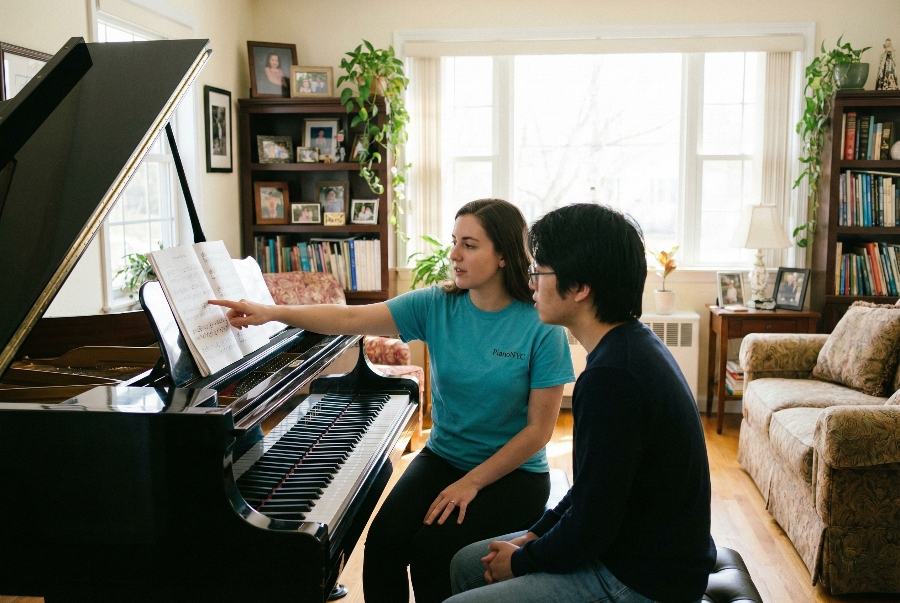
PrivatePianoLessons provides 1-on-1 in-home private piano lessons for adult learners across Manhattan, Brooklyn, Queens, The Bronx, and Staten Island. Coordinated from 817 W End Ave in Manhattan, our 48 degreed instructors bring customized piano education directly to your home with a 0 USD travel fee. Learn more about our programs at privatepianonyc, including specialized tracks such as music appreciation for seniors.
- Convenient in-home 1-on-1 instruction across all 5 NYC boroughs with zero travel fees
- Flexible scheduling from 07:00 to 21:00, 7 days a week, built around busy professional routines
- Customized adult curriculum emphasizing practical chord voicings, lead sheets, and preferred songs
- Complimentary 30-minute in-home evaluation and comprehensive progress reviews every 12 weeks
FAQ: Beginner Piano Songs
What’s the Easiest Song to Learn on Piano First?
“Let It Be” by The Beatles is the easiest pop song for adult beginners to learn on the piano. The piece requires only 4 basic chords (C, G, Am, and F) moving in a predictable progression within 4/4 time. Its steady quarter-note harmonic rhythm and intuitive right-hand melody allow adult novices to play a recognizable complete song within 2 to 3 weeks of consistent practice.
Do I Need to Read Sheet Music to Learn These Songs?
You do not need to read traditional grand staff sheet music to learn beginner pop songs on the piano. Most contemporary pop selections can be mastered using lead sheets, chord charts, and Roman numeral harmonic notation. Professional instructors teach practical chord theory and tactile keyboard navigation first, introducing formal notation gradually as technical confidence expands.
How Long Will It Take to Play My First Full Song?
Most adult beginners learn to play their first complete pop song on piano within 4 to 6 weeks. Committing to 20 to 30 minutes of daily deliberate practice produces consistent motor consolidation and finger independence. Working 1-on-1 with a private instructor accelerates progress by immediately correcting posture, fingering, and rhythmic hesitations.
Should I Start with One Hand or Both?
You should always start by practicing each hand separately before attempting two-hand coordination. Isolating the right-hand chords for 5 to 7 days builds clear spatial memory before introducing left-hand bass notes. Combining both hands after each part is secure prevents cognitive overload and establishes clean rhythmic synchronization.
